


Translated with the help of AI. We apologize for any errors and would appreciate your help in correcting them.
Translated by order of the educational portal university.poker
Original source: GTO Wizard
You make a raise from an early position (EP) in a multi-table tournament, and BB calls. You both have a roughly average stack of 25 bb. Without knowing anything more about your opponent or the flop, I can tell you that BB almost certainly has to play the check on the flop. In response, you should usually bet a small bet (25% of the pot or so), and a player on the big blind should fold most of the cards even with such a small bet. All this follows from the preflop bands that you and your opponent have.
You need a relatively strong hand to open with the EP, whereas BB can call to a much wider range because on the preflop it has the last word and it gets a very good price to see the flop. This means that the EP will have a significantly stronger range on most flops, and this edge you can use to put cheap bluff, thin vellya and protect your more vulnerable hands. At this depth of the stack, even your strongest hands do not mind a small bet on the flop, as they will be able to get the rest of the chips with reasonable bet on the turn and river.
Flops without higher cards interfere with the plans of the preflop racer.
However, flops without higher cards interfere with this plan. Even if you raise with an EP, you have a lot of unpaired hands on such flops. Prolonged bet in this case makes you vulnerable to check-raises. On such flops, it will be correct to check more often, and with a more polarized range, make a larger bet. Anyway, this is exactly what the chip EV simulation shows. The opposite of this is the idea that the ICM environment usually uses smaller bet sizes and is less likely to collide with BB. To switch from the chip EV model to the ICM model with customization for the field game, use the "Custom range" function.
Will a more Tight range BB preflop call (due to ICM) result in smaller continued bets from the racer from UTG? Let's find out.
1. preflop range
ICM encourages players (both preflop raise and BB callers) to build their range in a slightly different way. At the same time, the differences are more significant for BB. The range of the UTG rise actually expands a bit: from 17% in the chip EV environment to 18.3% in the ICM environment with the remaining 25% of the field.
UTG 25bb opening range: chip EV vs ICM:
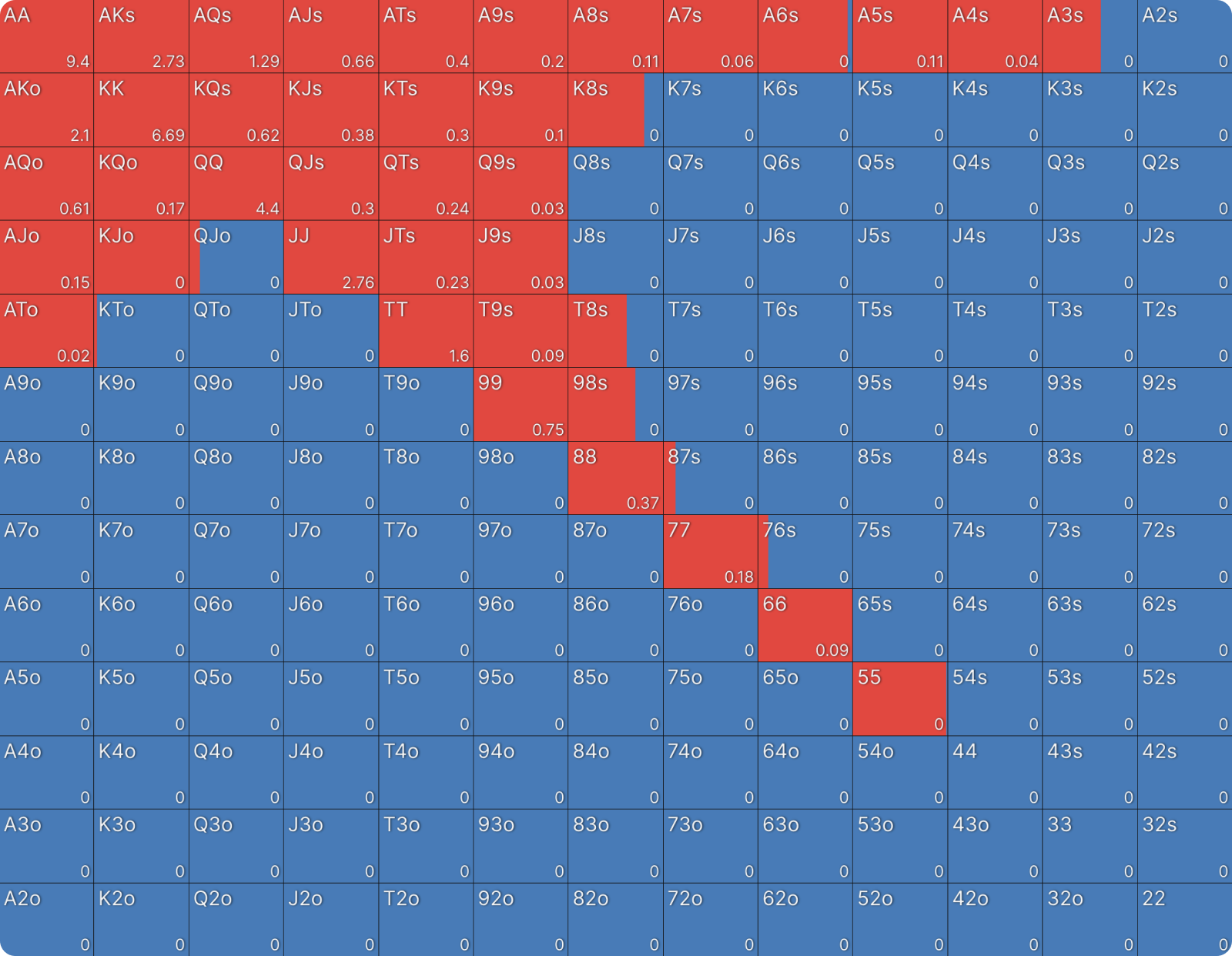
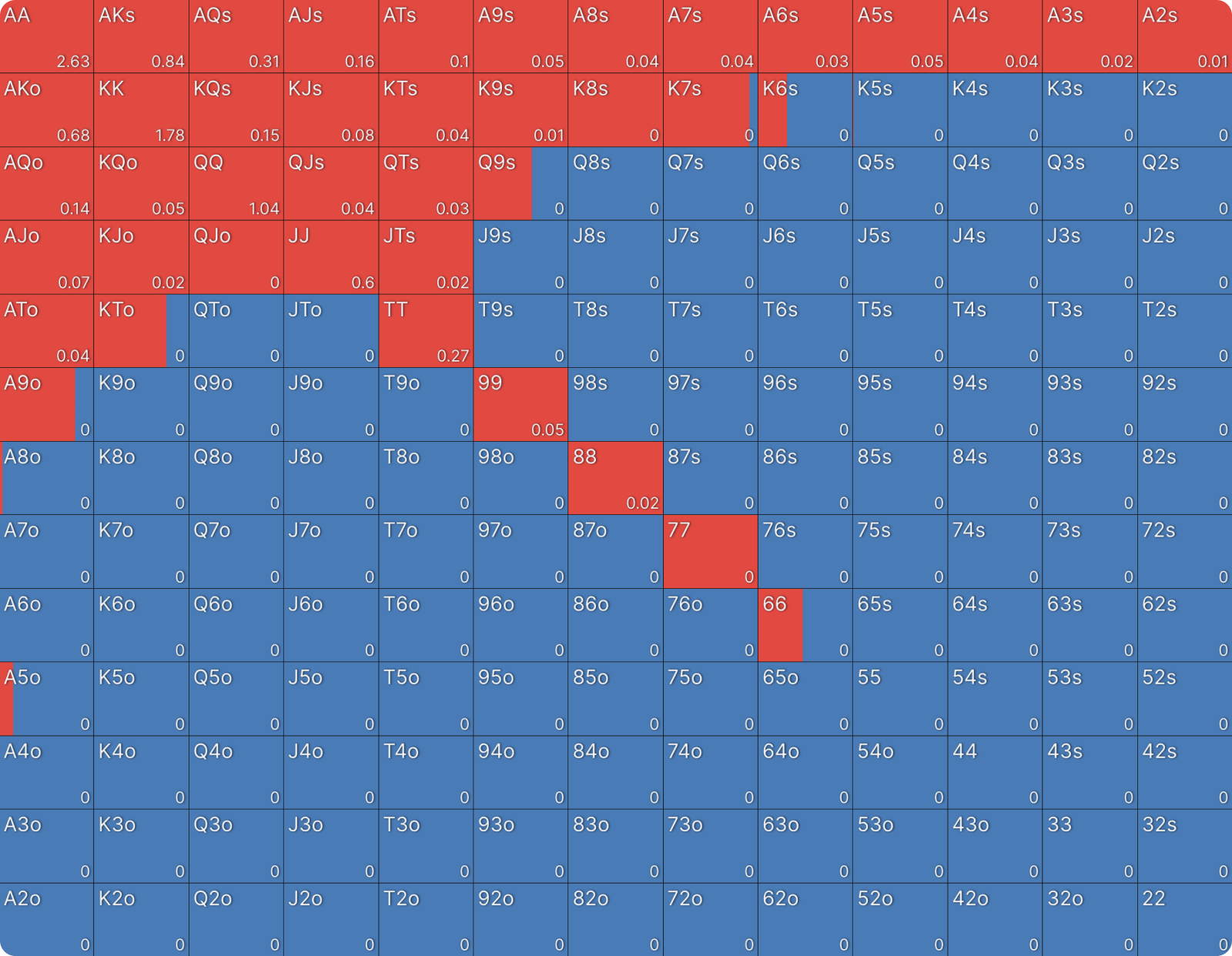
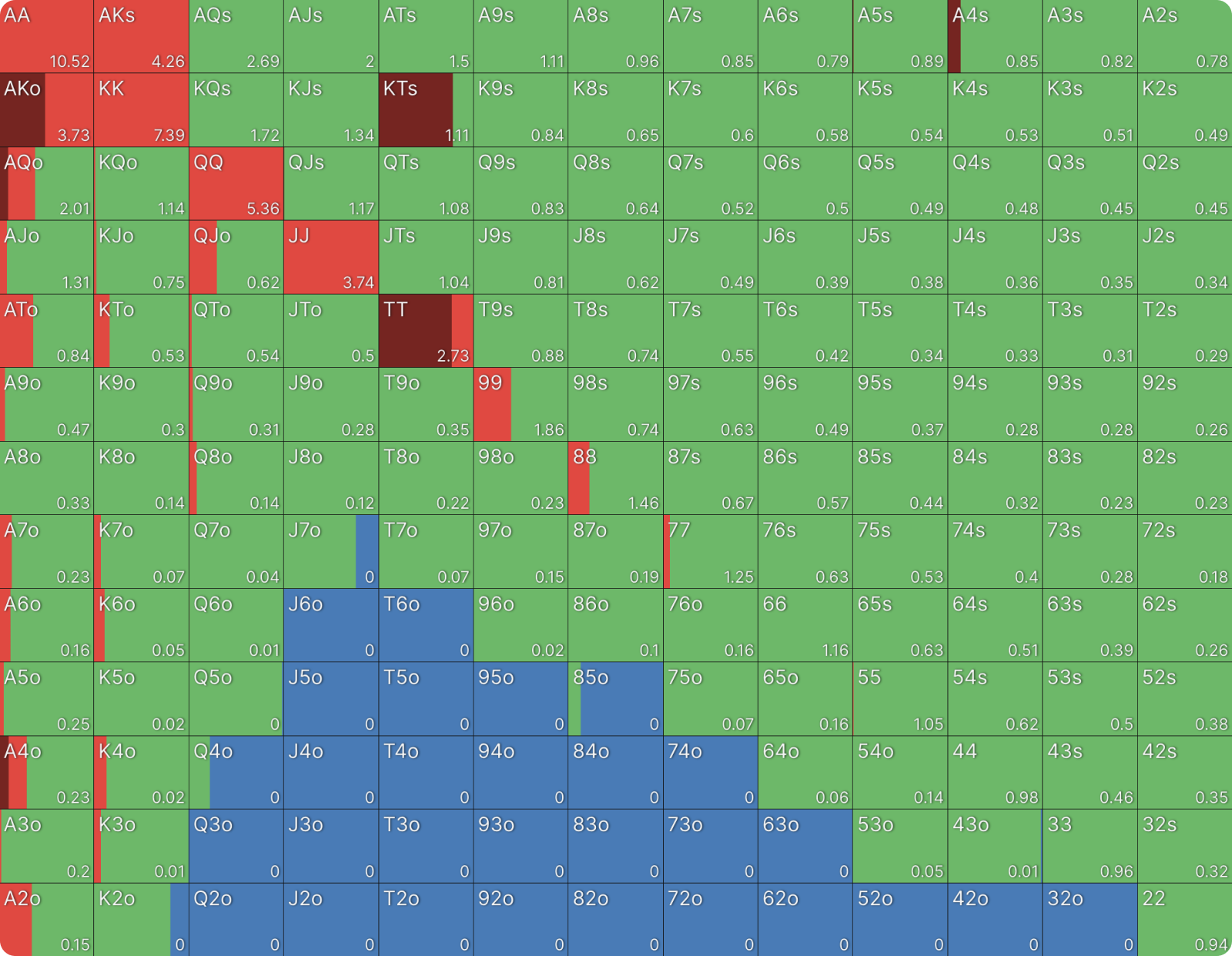
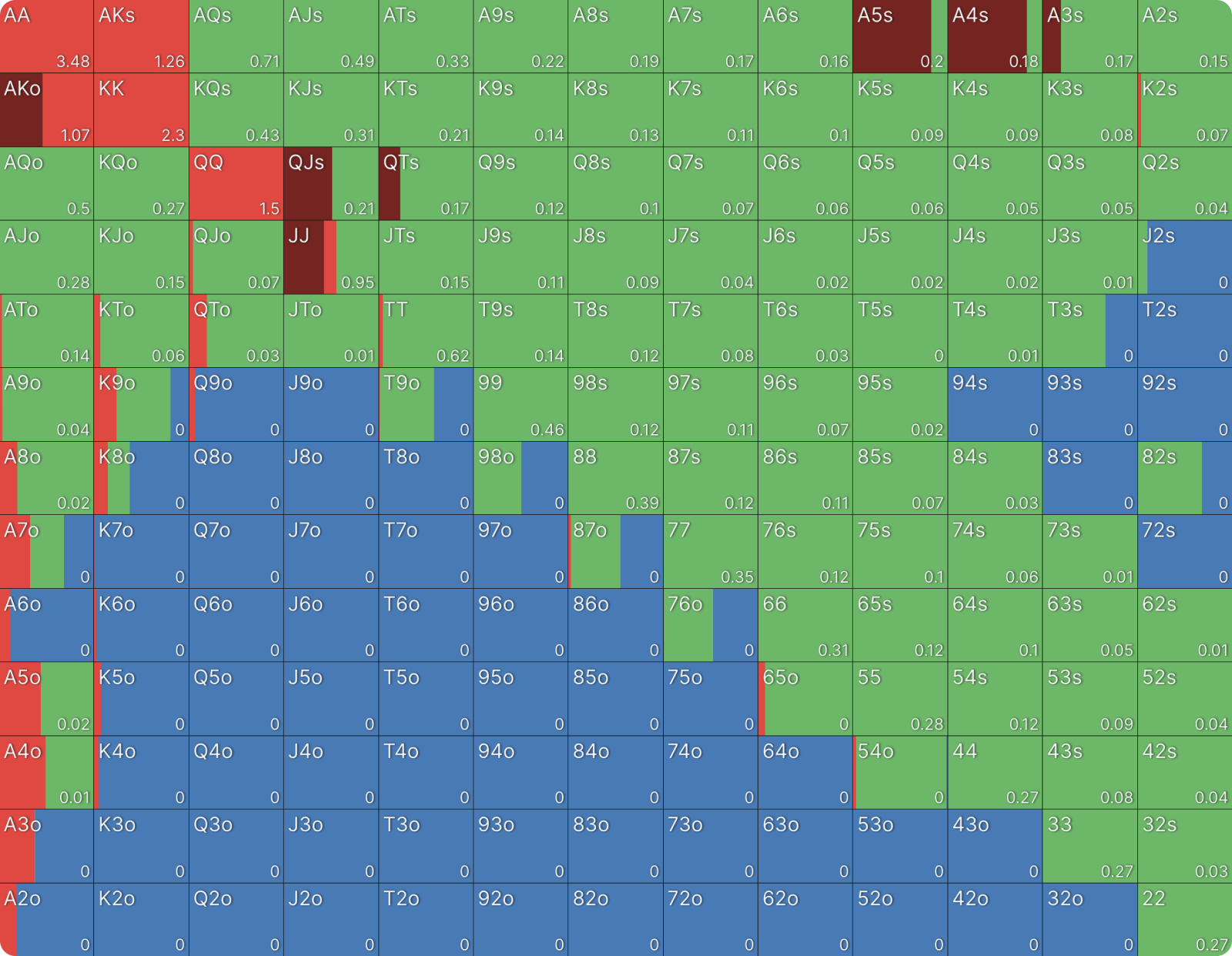
However, the call on BB decreases from 67% of the hands in the chip EV environment to 40% in the ICM with the remaining 25% of the field. The number of folds with low, unbound suited hands and unbound offsuited hands with one big card increases (if there is no one, then the offsuited hands fold immediately even in the chip EV environment).

Call range BB, depth 25bb (green):
2. bet continuation strategies
This abrupt change in BB's pre-flop range does have major implications for UTG's continued post-flop bet strategy. To demonstrate this, I simulated a post-flop game using both sets of ranges. In all cases, the post-flop simulations use the chip EV model (i.e., neither player's post-flop strategy takes into account ICM pressure) and the same bet size options. The only difference between the two is the preflop range.
In the chip EV environment, UTG makes continued bets with more than 60% of the bet hands on the flop

 , and the most commonly used bet size is 80% of the pot:

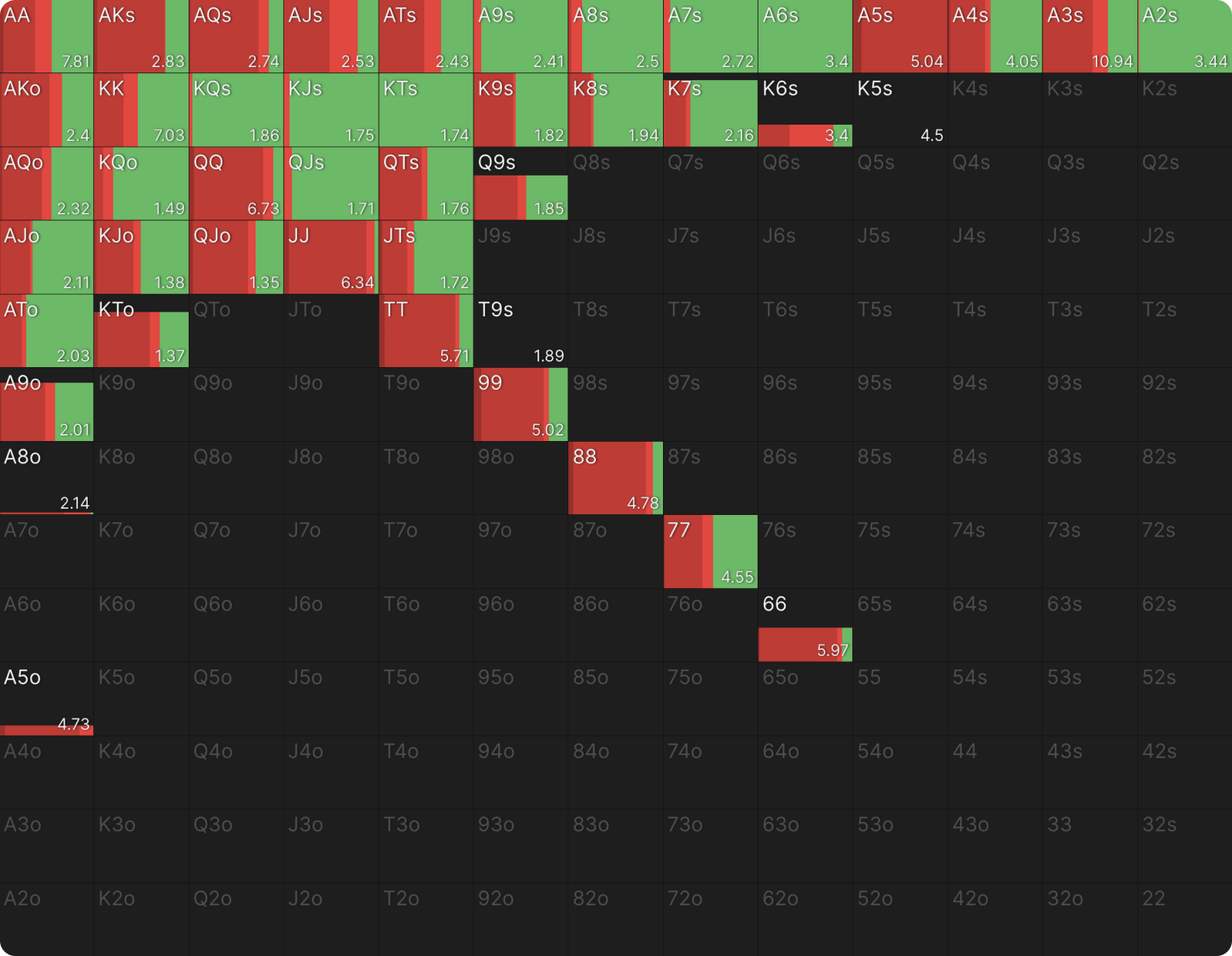
In the ICM environment, UTG continues to put barely half of its range and mostly it is 50% of the pot, not 80%:
BB should have a stronger call range considering ICM, and this makes counterbets less desirable for preflop razor.

Again, these post-flop simulations do not sufficiently take ICM into account. Thus, UTG will place bet less and less frequently. Despite this, the trend is obvious: BB should have a stronger call range, taking into account ICM, and this makes cbets less desirable for preflop racer. In both simulations, large UTG bet rates are driven by available overpairs. The Type 88 hand benefits from immediately putting money into the pot because (although it is currently a very strong hand that can get a call from the worst pair or force hands with six live outs to fold) it will not be strong enough to bet on many thorns and rivers. These overpairs always put 80% of the pot in a wider range in the Chip EV environment against BB, who is more likely to catch a smaller pair on the flop and less likely to catch a better hand.
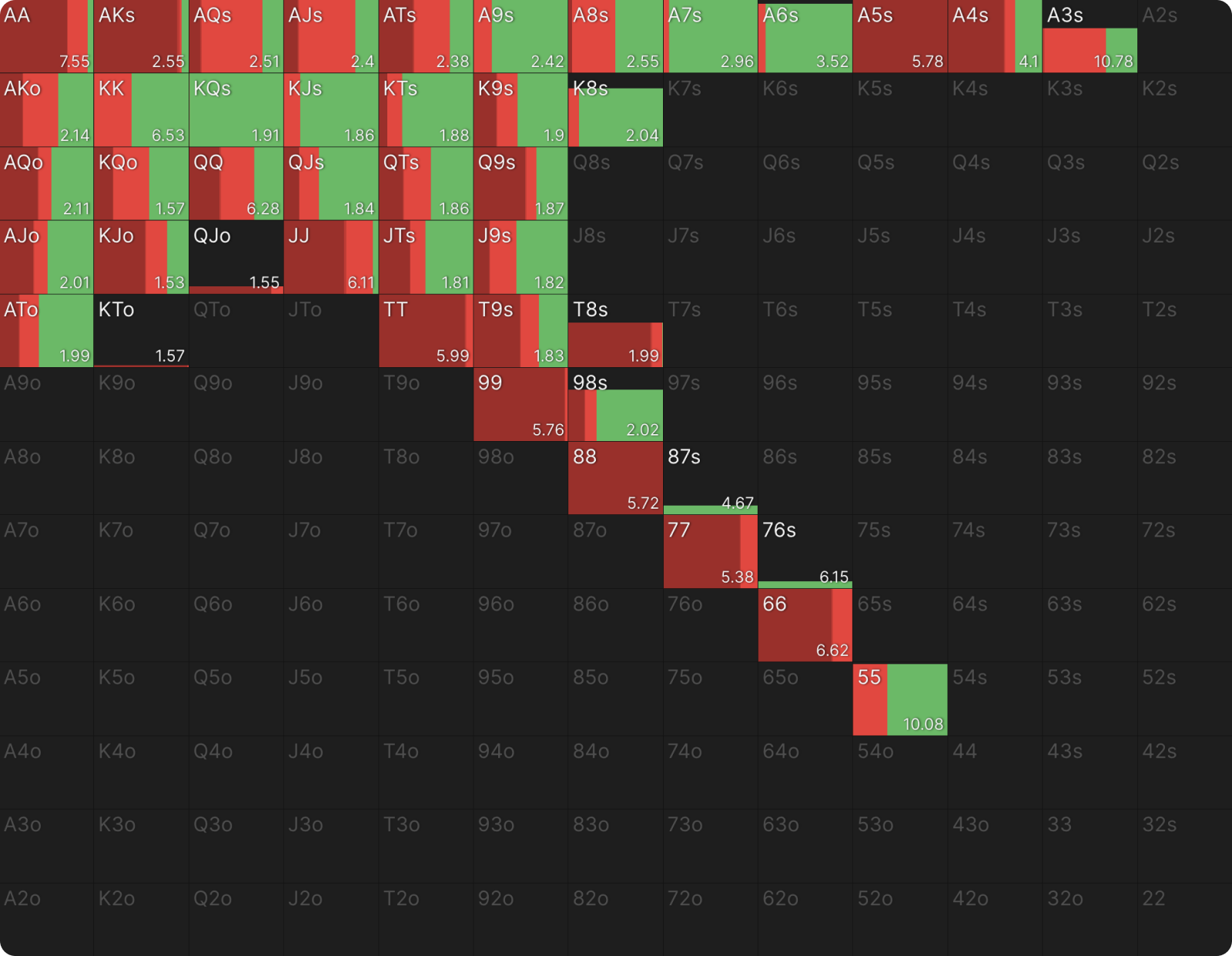
Against the more secretive ICM range, these overpairs are indifferent to rates and usually bet 50% of the pot instead of 80%. BB doesn't have many second-hand hands with which he can pay, and he may even have his own larger pocket pair.
3. Another example
Due to the fact that it is not yet possible to prescribe our own bet sizes, we can independently set such flops, where the chip EV model will use the big size of the extended bet as a preflop raise. This will ensure that these patterns persist. Flop 
 retains the ability to collect straight, but adds flush draw and removes all overcards+Ace-x gatshots from the UTG range. Nevertheless, a comparison of Chip EV and ICM range solutions shows the same picture: UTG bets less and less often in a stronger range BB, practically excluding the sized rate of 80% of the pot.


Again, since there are fewer small cards in the BB range, it has fewer good goals for Velu Betas, and therefore less incentive to invest.
4. Another example
Something more amazing is happening on the flop 
 .
.
In the Chip EV environment, the solver almost does not use the 80% pot rate, preferring to bet 50% of the pot with the range:

But when calculating in the ICM environment, the bet of 80% of the pot is more often used!

This strategy also uses a check and a 50% bet in 17% of cases, which is key to understanding what's going on here. UTG still invests less money in the pot on average, playing against a stronger BB call range. As we have seen in previous examples, UTG has already used a polar bet strategy against the Chip EV range. When, due to ICM pressure, the BB range strengthened, the UTG strategy retained this polar shape, but less often and with smaller bet sizes. On the flop,
UTG's strategy against the wider range of chip EVs was linear: a 50% pot bet. Against the ICM band, he generally makes less bet and moves to a slightly more polar strategy.
Do not make bet here modest pocket pair and weak Aces:
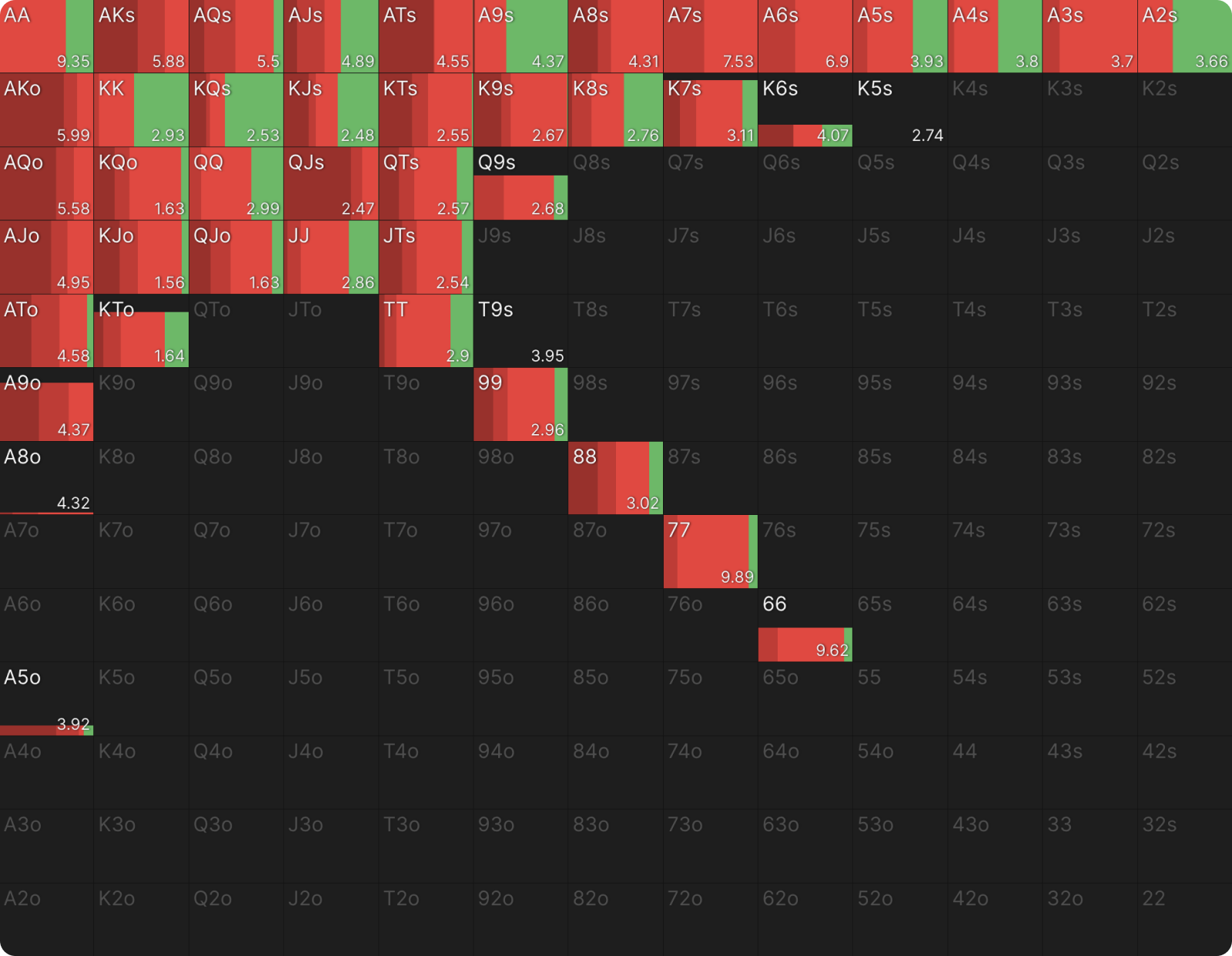
These are good hands, but since there are fewer smaller cards in the BB range, they are less likely to call 7-x or 6-x when betting UTG, and so he bets less often.
5. Deeper stacks
In this final experiment, we will return to our original flop, but with a stack of 40 BB.
Here is the strategy in the chip EV environment:

And for the ICM environment:

For deeper stacks, UTG still finds use for larger bet sizes. But the pattern persists: UTG checks more often and less often places large bets in a stronger BB range.
6. Conclusion
Post-flop strategy does not exist in a vacuum. A significant change in your opponent's pre-flop range should result in a significant change in your post-flop strategy. In an ICM environment, this usually means that BB has a much stronger call range than the Chip EV environment assumes. As a result, the edge of the range of the preflop racer decreases, and therefore it should invest less money in the pot. Compensation for the need to restrain your c-bet on the post-flop comes in the form of additional folds on the pre-flop. When the ICM pressure is high, your open raises will often take pots on the pre-flop, and that's great. But you have to admit that you won't be able to bluff or get the same amount of valleys on a post-flop value as often.