

Translated with the help of AI. We apologize for any errors and would appreciate your help in correcting them.
Translated by order of the educational portal university.poker
Article by Andrew Brokos, original source: GTO Wizard
A pre-flop racer who makes extended bet too often is always a potential target to exploit, but the best opportunities to profit from his mistakes come when he is out of position (OOP). Being without a position, preflop razers often continue to put counterbets as often as in a situation when they are in a position (IP). If you are a caller in a position, understanding how to get the most out of this mistake will come in handy.
There are two competing logics here. On the one hand, experiments with a game without a position show that raise is the best option, since it deprives the opponent of equity with his smaller bets. On the other hand, a player in a position is usually better off letting a hand play out on the late streets, where he will have a positional advantage, than completing it immediately on the flop edge. In this article, we'll run some experiments to help you reconcile these opposing thoughts and make the most of the opportunities created by players making excessively frequent continued bet when you have a position on them.
1. Static flop
Static flops are beneficial for a player without a position. Such board allows players to predict the strength of their hand on the river and place appropriate bet.
Static flops are beneficial for a player without a position.
In stacks of 40 BB, the single raise pot between UTG and BTN at the respective opening positions of the solver gives UTG EV 3.95 BB on the flop

 , which is almost 56% of the pot.
At the same time, UTG counterbet more than 70% of the time, preferring a small bet size:
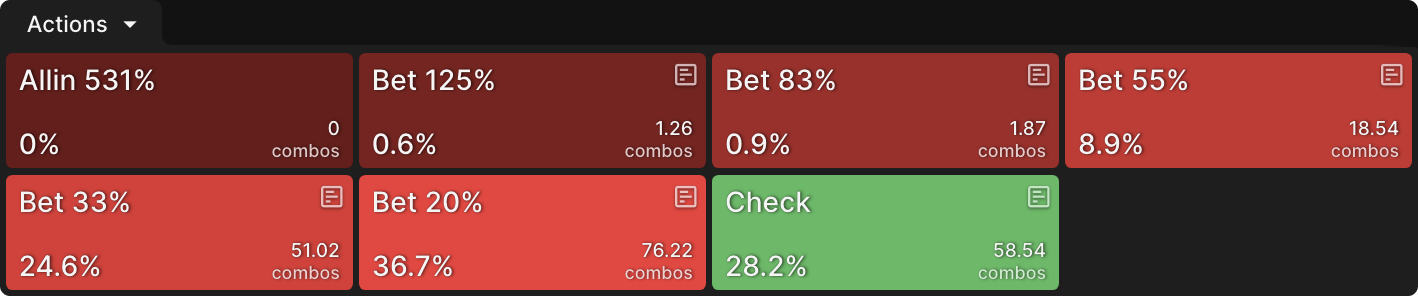
BTN responds to these small bet mostly by call. Sometimes he folds, but this is not enough to make a bet on any two cards profitable for UTG.
Here is his answer to the 20% pot rate bet most commonly used by UTG:
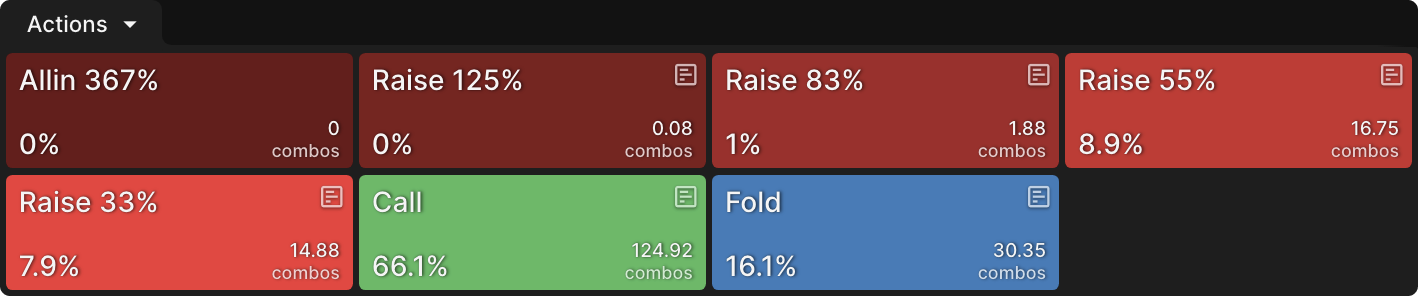
Despite the fact that UTG prefers to check in 28% of cases, if you force him to put 20% of the bank with his entire range - it costs him only 2bb/100 EV. Then the BTN response also does not change significantly.
He calls even more often, both with some hands that would raise against a more balanced UTG bet, and with some hands that would just fold:
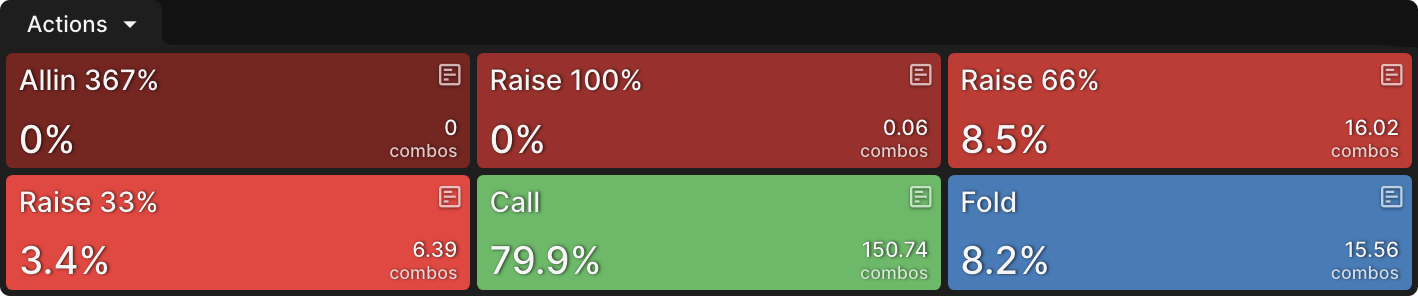
For a player outside the position, a small bet is not much different from a check. Both invest very little money in the pot and are at the same risk of the villain deciding to charge a higher turn price. This is a big difference from being in a position where the check guarantees a free turn, and the bet will resume trading, allowing the enemy to make a raise.
For a player outside the position, a small bet is not much different from a check.
Thus, small bet with too high a frequency is not a big hindrance for a player without a position. This can even prove to be a winning strategy if the player in the position folds too often. Even on boards that favor the raiser, you should be extremely stubborn against such bet ting.
2. Increased bet
In a simulation where UTG is allowed to wager only 83% of the pot or play a check, BTN applies an even stricter call-or-fold strategy in response to a bet:
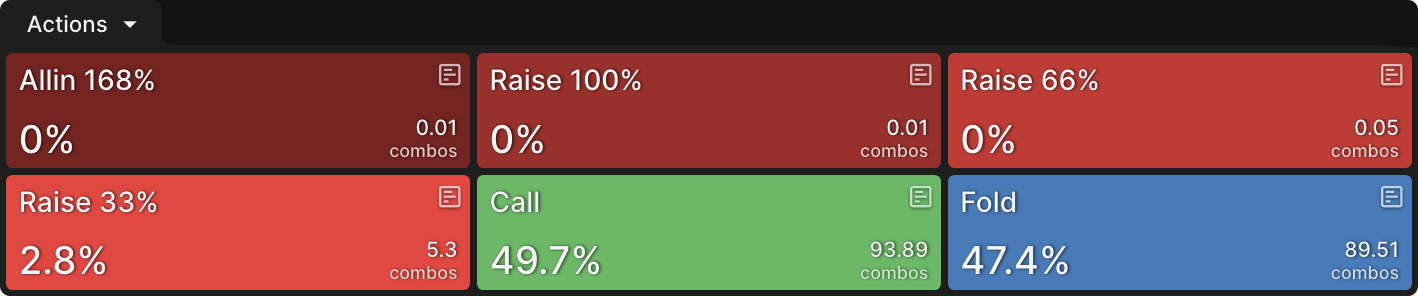
This restriction does not cost UTG much EV, about 3bb/100 less. However, the opportunity to make a check is much more important for him when the alternative is a big bet. UTG makes a bet only about ᐈ times in equilibrium, and when it is forced to make a range bet, but sized 83% of the pot, it loses almost 40bb/100! If this is properly operated by BTN.
The frequency of BTN folds is decreasing slightly, but a big change in his strategy is the renewed interest in the raise:
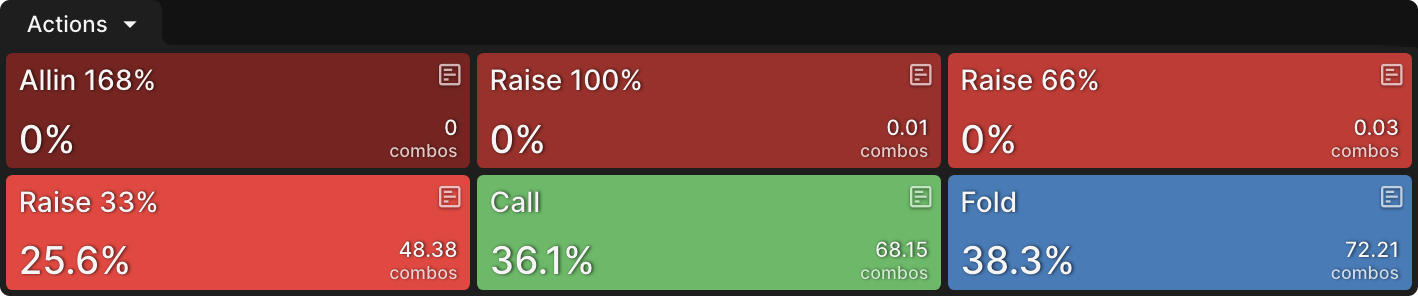
If it is possible to make a check, the bet range UTG is polarized, as it should be with a large bet size:

Raise will simply cause UTG to drop their worst hands, which have bad equity anyway, and continue to play with strong ones, against which even stronger BTN hands may not look as good. Medium strength hands are the ones that will face difficult decisions when raising, but UTG still doesn't bet with them. But if UTG makes a bet with medium strength hands, then the raise will already become attractive for BTN.
Compare EV helps us visualize which hands are best to use:
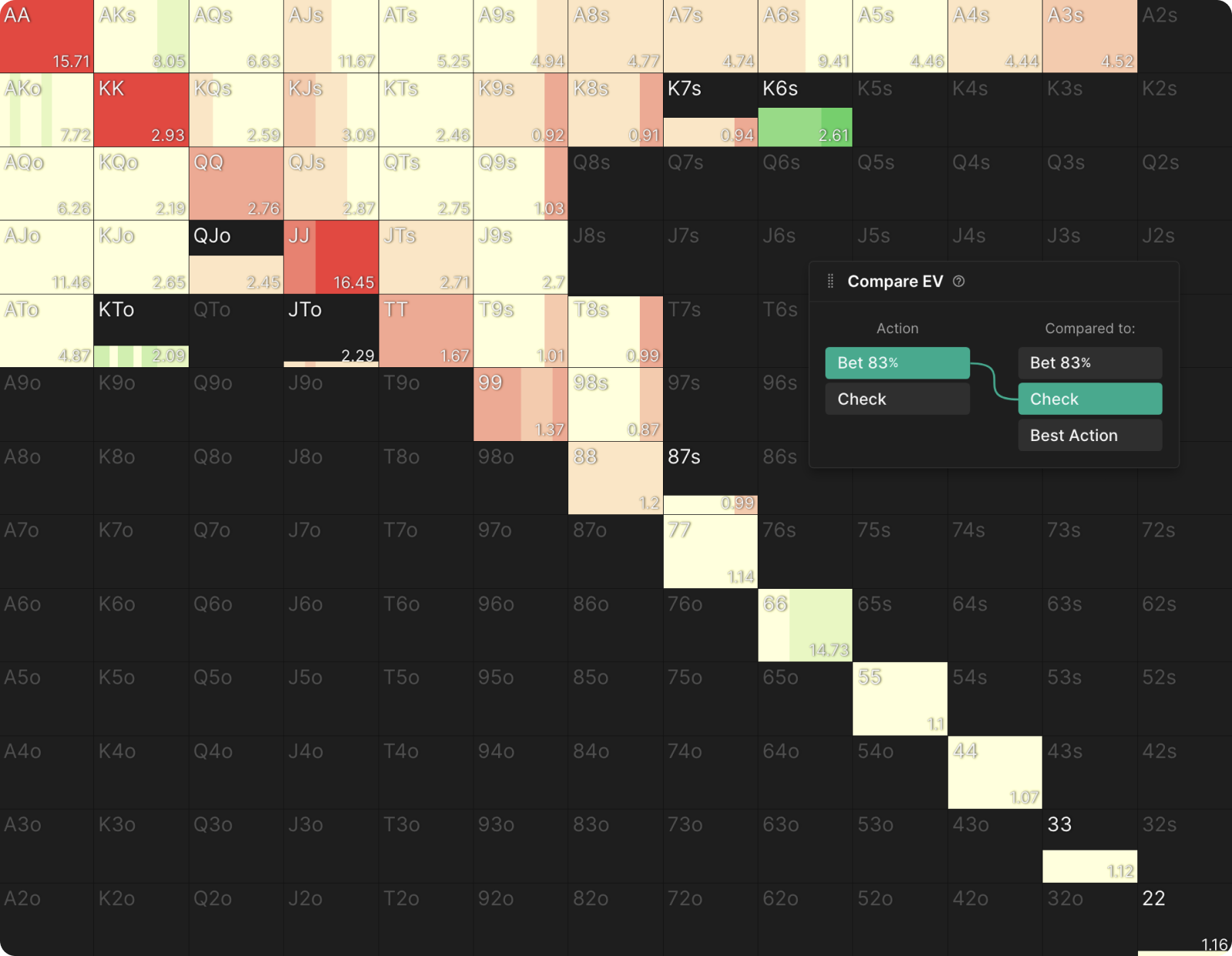
Due to the strong blocking effect on the second hand, the top and middle sets are actually the worst hands for UTG bet! The lower set, 66, unlocks the call range and is an excellent valley bet. But besides them, the worst hands for a bet are hands of medium strength: the middle pair, pocket pair, top pair with a weak kicker, etc. All these hands would very much like to get a raise.
Some people are more concerned with winning the pot than maximizing their EV.
Is it realistic to think that a person in the place of UTG can make a larger bet? Like any exploit, it depends on the player. Of course, there are players who will place a bet to “represent the ace” or “pick up the pot now” when they have a middle pair. In fact, they are more concerned with winning the pot than maximizing their EV. You will have to make a judgment as to how well this applies to a particular opponent, but it is useful to have such a specific question to focus your thinking.
“Will this player bet here with medium strength hands such as QC?” is a more specific and therefore more useful question than “Will this player bet too often?” since not all hands lose a lot of EV andbecause of higher frequency bet or because of a raise. The exploit range of the BTN raise is mostly linear. The closest to a pure bluff is the 54s, which, in addition to their backdoor draw (except 
 that will never raise on the board ), unlocks the weaker UTG hands in a way that other backdoor draw hands, such as T9s, do not. In addition, lighter raises are hands such as the middle pair, the lower pair with a good kicker and large gatshots such as KQ, which also have overcards to the middle pair.
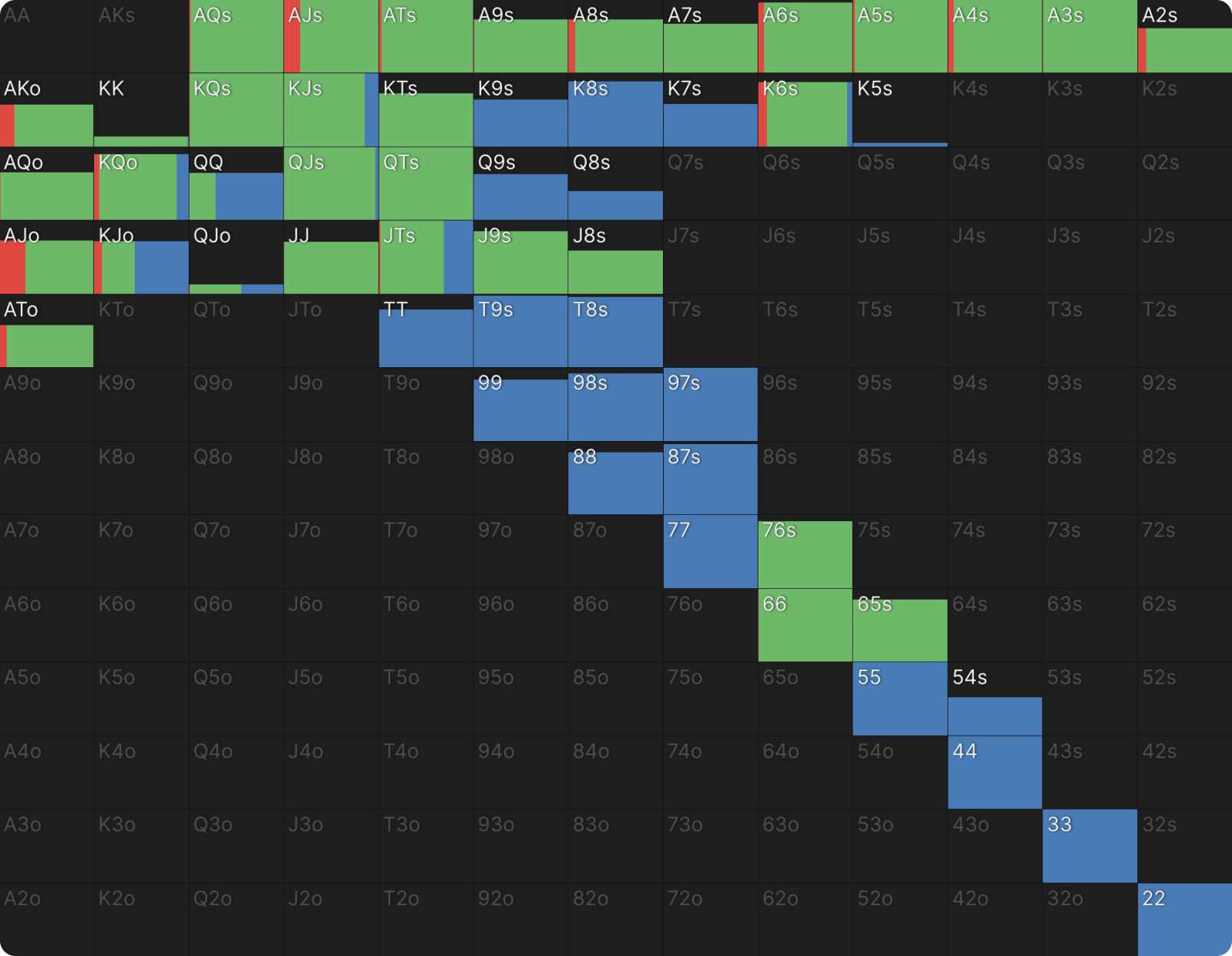

On a static board that favors the OOP-raiser range, too frequent a bet is not necessarily a big mistake, even if it is a big deviation from the equilibrium strategy. The most important thing for his opponent is to stubbornly call against his small bet and make him play without a position on the late streets. If he bet too often, he will lose a small part of it that he could have saved by making a check. If he makes too many and too large bet bets, then the possibility of exploitation opens up. It will still be right for the opponent to fold more often, since the raiser has a lot of equity. But when he decides to continue, he should think about a raise, which would put the player's middle hands, with which he really shouldn't have put, in a difficult position.
3. Dynamic flop
On dynamic flops, excessive continued bet can indeed be superfluous. In the depth of 40 BB stacks, the single raise pot between UTG and BTN on the board 
 solver gives UTG EV 3.36 BB, which is less than half of the pot.
He continues to place bet about 35% of the time, mostly 33% or 55% of the pot:
On dynamic flops, excessive continued bet may be superfluous.
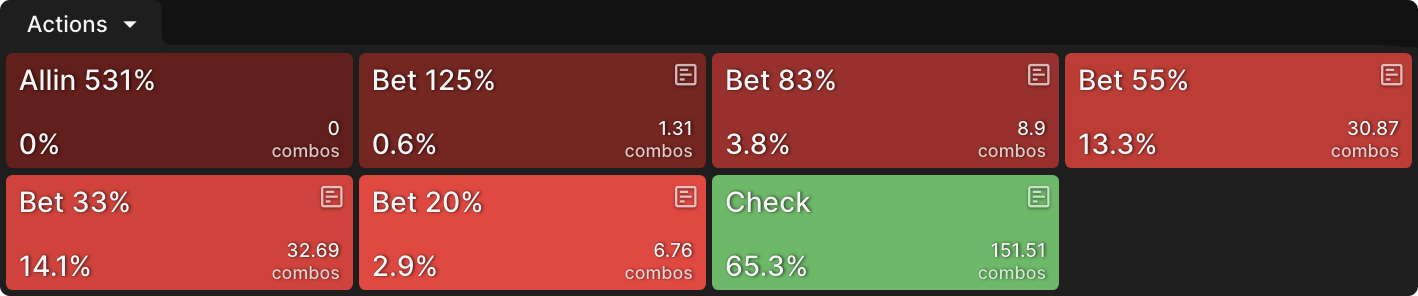
We have already seen that if a player is going to make continued bet too often, small bet is the safest way to do it. Check is the most commonly used option, so if we set up the solver so that we do not use it, the next best option is a bet of 20% of the bank.
If you set the solver to slightly limit checks or bet for UTG to 20% of the pot, then this in itself will not be a big hindrance. This reduces its EV by 3bb/100 and, importantly, does not increase the frequency of bet. He still prefers to check about twice as often as he does bet. BTN almost never folds on this small bet. It is difficult not to have equity on this board, you can also count on a very high implementation of equity on the late streets due to its positional advantage.
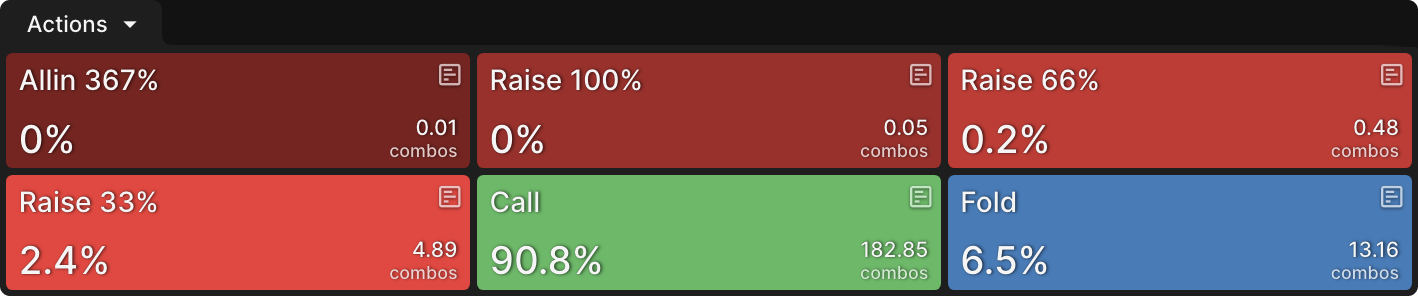
Forcing UTG to put 20% of the pot with its entire range reduces its EV by another 7bb/100. Against such a wider range of bets, BTN never dumps bet.
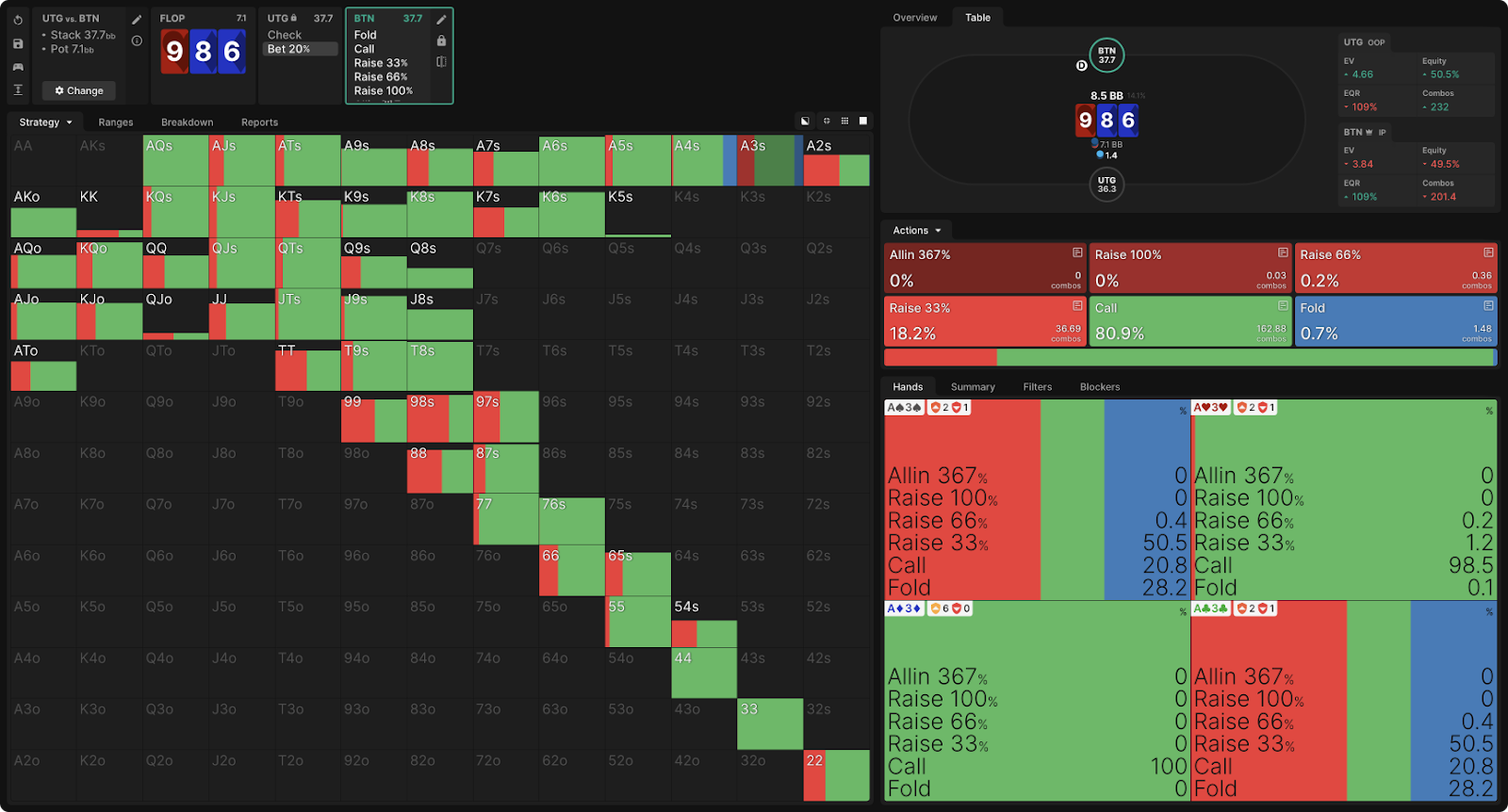
It has a significant raise range, but the call remains the predominant option:
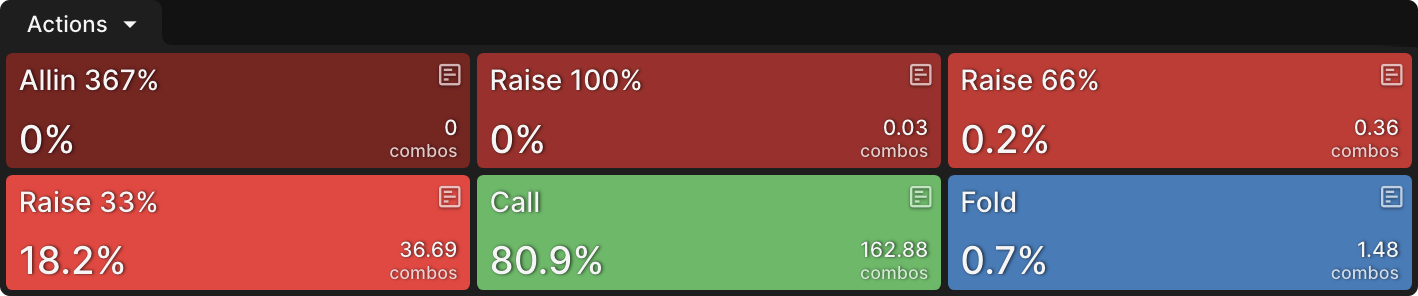
There is some fine value/protection in the rise range, but this is where some of the worst hands are. BTN rarely folds if UTG bets too often bet. Very few hands completely bluff on this board, but even those that do, for example , can either bluff right away or float and bluff on the turn when they are waiting in them. UTG just has too many weak hands on this board.
4. More about the increased rates
If you limit the check or bet for UTG to 50% of the pot, it will not hurt his EV, since the bet is more than 50% - about the size of the bet that he prefers to use in any case.
BTN is even less likely to raise the bet against this larger bet and, of course, more likely to fold:
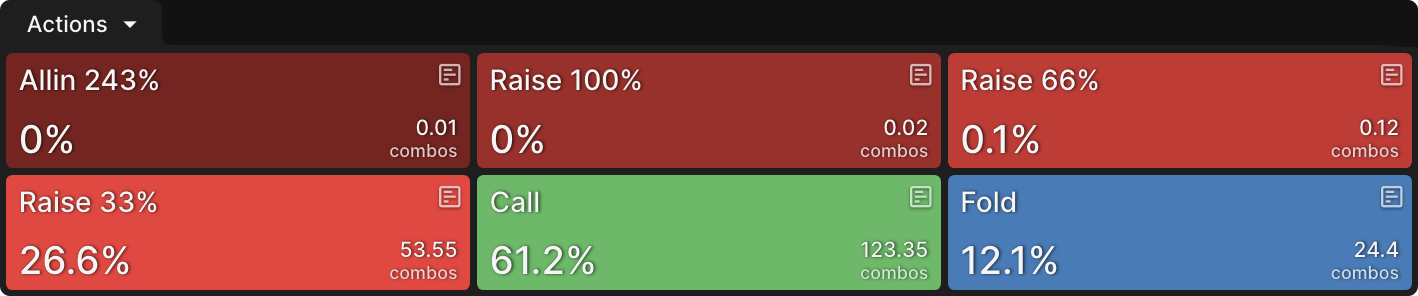
However, if UTG is forced to make a range bet of 50% of the pot, its EV will decrease. It will drop to 3.12 bb, a loss of 24 bb/100 compared to its equilibrium strategy.
As before, BTN mainly uses raises to attack the middle of the UTG bet range, which consists of overcards without significant draw:
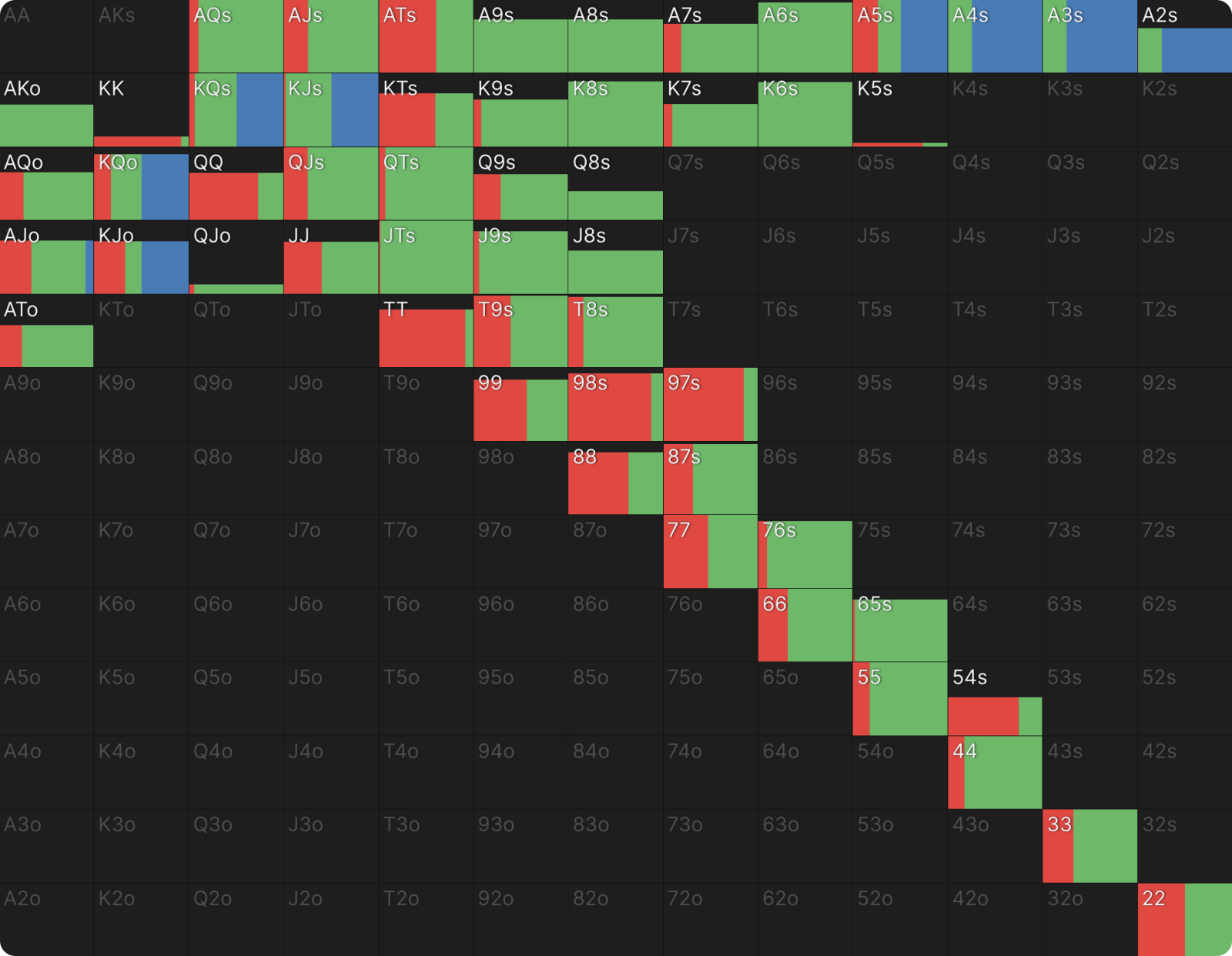
For BTN floating or bluff raises with the worst hands are too expensive against this larger bet, but its standards are low: two overcards with a backdoor flush draw are enough to compete for the pot:
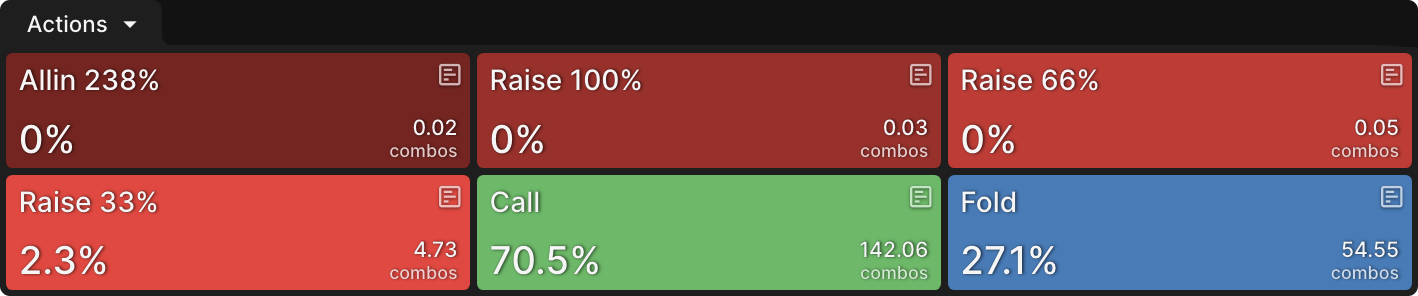
The most important raises are not bluff, but hands for delicate value/protection, especially overpairs. For these hands, the raise is a win-win proposition: they are strong enough to beat the worse hands, but they also benefit from dropping the opponent's live overcards.
5. Other exploits
While on the BB, think about how to call out more broadly against a player who you expect to make counterbets too often.
This adjusting will increase the EV of each hand in your range, so some that usually play a little better on a fold or raise will end up being more profitable on a stake. Technically, the same is true when you have a position on the racer. If he does counterbets too often, your EV will increase, so some hands that would otherwise folds or cut could be better played with a call. The difficulty is that, unlike BB, you do not close the action (you do not have the last word). Other players may still be able to call or raise the bet after you, and they will have an additional incentive to do so if they suspect that you are calling wider than usual. Unless you are on a BTN, I would advise against extending the call range in a position. Even on BTN, it is best to play with passive and non-observant blinds.
6. Conclusion
The worse the board for the preflop racer, the greater the error for him will be the c-bet with a high frequency, especially if he prefers a larger size of his bet. The best candidates for “extra” raises are not your worst hands, but rather the middle hands of your range, hands that might otherwise make a call against a less aggressive opponent. Like AK on preflop, these hands benefit from folds, but work reasonably well against calls.
Raise on a bluff can also be profitable, but this will require your opponent to make an additional mistake in the form of an overfold, which will be easier to do after a bet with too many weak hands. Finally, it's important to understand the theory behind why dock betas are a mistake if your villain makes counterbets too often. If you expect your opponent to make a mistake in some future node of the game tree, you have an additional incentive to tweak your game at earlier stages of decision making. This will increase the likelihood that your villain will make the mistake you intend to exploit.
- There is less equity in its range.
- The board is very dynamic, which exacerbates the lack of position.
Each of these factors reduces the likelihood of the pot winning by the racer, and therefore makes the growth of the pot less desirable for it. Flops with medium cards tend to match both of these points, combining most of the cold-call range, but very few hands become so strong that they can be sure of their strength without paying attention to the cards on the turn and river.
A player who makes too many counterbets on these boards will lose a lot, even if you don't take any action to exploit them, simply because he invests too much money in the pots compared to his chances of winning them.
You can tighten the nuts by dropping even less than usual (floating with any equity is especially effective on such boards). If you suspect that he puts too many hands of medium strength, also think about your raise range. It is best to apply these raises in terms of fine value, protection and semi-bluff, rather than pure bluff, which is generally not profitable unless you suspect that your opponent will fold too often.