
Cbet (continuation bet, or c-bet) is a standard technique in poker when a player who has made a preflop bet continues aggression on the flop. But what if the flop is dangerous for the racer or you are playing against a player with a high check-raise rate? Here, a delayed cbet comes to the rescue – a delicate tool in the arsenal of an experienced tournament player.
In this article, let's take a look at:
- What is a delayed cbet?
- When to use it?
- Examples from real hands
- Mistakes to avoid
1. What is a delayed cbet
Delayed cbet ( delayed c-bet) is a skipping the bet on the flop with the intention to put on the turn. Unlike the classic c-bet, the player does not attack immediately, but waits for a more favorable moment. This is especially important when playing tournament poker, where one mistake can cost you dearly.
2. Situations for deferred c-bet
Razor Adverse flop
If a flop came out that is completely inappropriate for your range, but well suited to the spectrum of your opponent. On such a dangerous board, without a strong ready hand, your cbet may just be a waste of money. However, on the turn, the situation changes dramatically, and after the second check from the blind, the bet from Hiro is more than convincing.
It is noteworthy that in the case of a double check from a big blind, it makes sense for you to put a backlog on almost any runaway, since a double check from an opponent is a kind of unspoken surrender. (The latter statement should not be taken in absolute terms. There are no actions with 100% performance in this game. However, there are lines that show the highest yield, which is why they should be used at every opportunity. Author's note)
3-way pot in position
Take a look at the picture below.
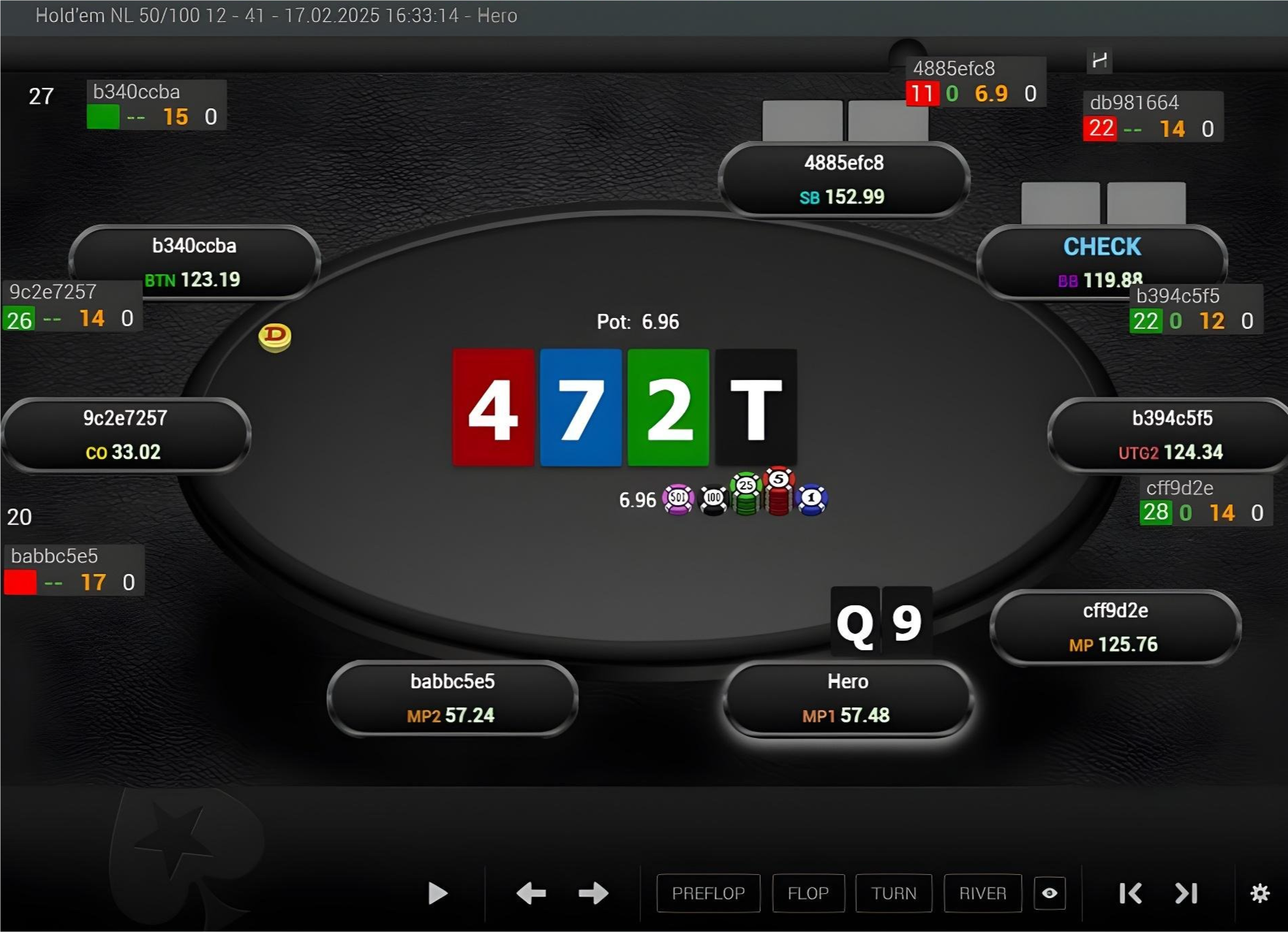
Hiro flopped an interesting board — a low and rather dry board. It is good to counterbet such flops into one opponent, but here he plays in a multipot, which somewhat reduces the chances of a successful cbet. So a check without a hand looks quite appropriate here. However, both blinds are waiting for the turn again. I usually classify similar situations as draw pots. And, as a rule, they are taken by the one who first makes the bet. I also recommend choosing sizing in the corridor of 50–60%, this maximizes your fold equity in such situations and creates some illusion that you, having got on the flop in the monster, decided to slow down a little, and now you want to get a larger sizing extract value. (If you play the single pot, the sizing may be lower, 35–45% depending on the woundout)
3 pot without position
This is a fairly common spot. Medium strength hands will be excellent candidates for such situations. Suppose AJo on a K-J-8r board. While waiting on the flop, you plan to play a check-call. But in case none of your opponents make a bet, for many neutral runouts you will have a great velyubet!
Slow play with nuts
Many poker players are well acquainted with the tendency of regulars fastplay to spit nuts (fast play — fast play). Indeed, this approach is quite justified, since on most textures you will almost always have something to get extract value from. However, everything has its exceptions.
Suppose you open with an EP and you have As-Ac. Your stack is 35 blinds. All fold, and a big blind cold-collite with a stack of 27 BB. Flop Ad-7h-7s and a standard check from your opponent. This is an example of the most dry and safe board for you.
Let's take a closer look at this board:
- Dro-textures such as flush draw, OESD, gatshots are completely absent.
- You have very strong blockers, that is, it is extremely rare for a big blind to have an Ah hand.
- In cases where the villain has flopped a thrips — he will still pay you for it on later streets.
You are waiting here on the flop to:
- give the opportunity to buy a large blind a hand of medium strength, a possible match or a flush draw;
- open a corridor for a bluff (or semi-bluff).
In cases where you still receive a second check on the turn, you should definitely make a bet, as otherwise you risk not getting any payment at all with your nuts. Now let's try to slightly modify the situation. Let's leave the board the same, but hiro will get two kings (Peak and Cross) instead of aces! Now this flop no longer looks so attractive to you.
However, even here our check on the flop has its advantages:
- we keep the pot small, in other words, we apply pot control already on the flop;
- there are practically no worse hands that will want to pay us on such a board.
In the case of a turn check, the bet will be the most convenient solution for us.
3. Why do shares work so well?
Having analyzed many databases of my students, I have repeatedly made sure that even inexperienced novice players usually have a good EV on deposits, not to mention stronger guys.
And here we come to the main factor:
Passivity of opponents in the distribution
Any player has a number of opportunities to try to seize the initiative in the hand before you can make a bet on the turn:
- Firstly, this is a banal donk bet (the donk line is considered in cases where your opponent does not have a position on you. In the event that you do not have a position, it becomes possible to place a bet on your check, which will look like a bet on a missed one. Approx. of the author). In this article we will not deal with situations where this can be a profitable action, because today we are not talking about this.
- Secondly, these are probe bet thorns. Many reg players have a very impressive statistical indicator of bet samples for thorns, about 70% and higher. This is justified by the fact that experienced players do not miss the opportunity to operate the initial racer if he refuses the standard extended bet on the flop (usually inconvenient for himself). However, there are a number of amateurs who prefer to play more on the card and in cases where they have not increased on the turn, they will most likely prefer to play check-pass if you put the turn.
It is these factors that create such a plus of the thorn line. Difficulties arise when opponents take the initiative, and it will not be possible to go to the delayed version of c-bet.
4. Alternative situations
A good player always has a plan for the hand. Let's analyze one interesting situation. The illustration above shows a rather dynamic CO vs BB spot. I wondered if I should counterbet the flop in such a borderline situation? On the one hand: I have some equity: the far straight and nuts nuts backdoor FD makes this hand at least not hopeless for me. I also note that there are a lot of hands in the big blind protection range that we are older on such a flop. However, in this spot I play against a rather aggressive opponent ( this observation was reinforced by the corresponding stats from xm3 that you do not see in the picture taken from the room player)
In the case of a check-raise, my further play will not be convenient for me, although it will not be a mistake to call on such a board in deep stacks. So I decided to take a free card without overclocking the pot on the flop. It did not turn out to go to the divisions, as my villain played probe bet samples, to which I responded with a raise! I am most impressed with this decision, since our raise, despite its semi-bluff, is also a value raise! We simultaneously flow and get from different draw textures that are generously present on such a dynamic board. These are small and medium flush draw in both suits, as well as any variations of straight draw from A-4 and 6-5 gatshots to quite possible Q-J type hands.
5. Mistakes to avoid
- Do not forget that the top frequencies of the classic extended bet on the flop ( in those situations when the IP racer) fluctuate at 88-92%
- Don't give up on exploiting your opponent's mistakes. (high fold on c-bet is gold
- Do not slouple premium hands on wood boards. (giving a free implementation is a mistake)
6. Conclusion
Delayed cbet can be classified as a subtle tool of timely aggression. With proper application, it will allow you to extract more valleys, and your poker strategy will make it more multifaceted and unpredictable. It is especially important to take into account the position on the opponent and the level of his aggression on the flop. As always, good luck at the tables!