

Translated with the help of AI. We apologize for any errors and would appreciate your help in correcting them.
This article is about how cognitive biases affect a poker player’s decisions and prevent them from evaluating their game objectively. It examines common thinking errors related to variance, recent results, sunk costs, and other psychological traps, as well as ways to recognize them and make more rational decisions at the table.

Translated by order of the educational portal university.poker
Original source: GTO Wizard
Part 2 of the article — Cognitive Biases and Their Impact on the Poker Game — Part 2
In another article, I mentioned that there are many cognitive biases and misconceptions that influence decisions in gambling, especially poker. Undoubtedly, this is related to the fact that the human mind did not evolve to naturally process variance and the kind of uncertainty we encounter in this game.
Indeed, a significant part of the research that led to the emergence of the terms for the misconceptions and biases we are going to examine was connected with gambling, since games of chance were often used as models. In some cases, these psychological misconceptions were discovered when their authors attempted to solve probability problems. Below are some of the most common misconceptions and biases that poker players encounter particularly often.
1. The Gambler’s Fallacy
The gambler’s fallacy, also known as the *Monte Carlo fallacy, is:
*On August 18, 1913, at the famous Monte Carlo casino in Monaco, the roulette ball landed on black 26 times in a row. As players watched the streak unfold, they increasingly bet on red, believing that an excess of red outcomes had to compensate for the impressive run of black ones. They lost millions.
The mistaken belief that a random independent event becomes more or less likely because of a previous random outcome.
For example, you flip a coin three times and get heads three times. This misconception will make you believe that tails must come up on the fourth flip. With a large number of flips, the results will follow a normal distribution, that is, a bell-shaped curve. This happens because coin flips are random independent events. In this case, each flip does not depend on the previous flips. “The coin has no memory.”
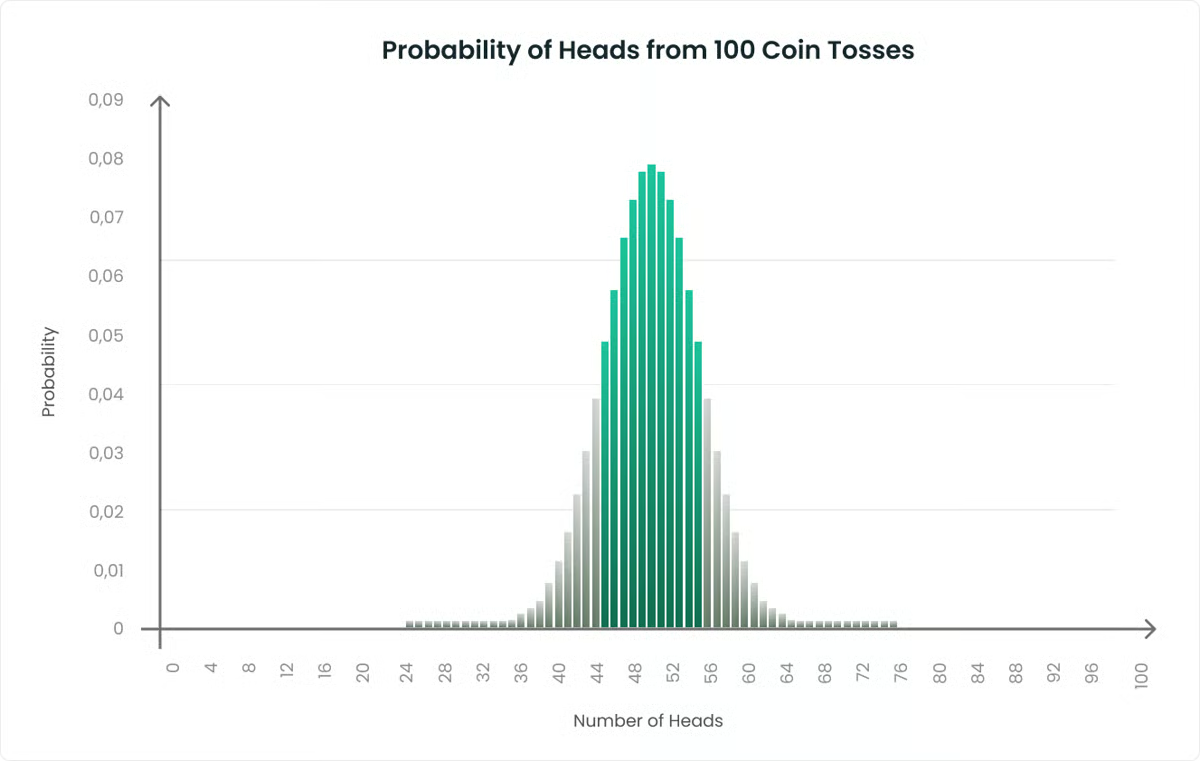
However, people find it difficult to process streaks that occur within such a distribution. For example, here is the result of a sequence of 100 coin flips that I obtained using an online random-number generator. The result was 49 heads and 51 tails:
TTHTHHTTHHTHTHHTHTTHHTHTTHHTTTHTHTTTTHTTTTHHHHTHTH
HTTTTTTHHTTHHTHTHHTTTHTTHHTTHHTTTTTHHTHHTHTT
There are many sequences of four, as well as one sequence of five and even six identical outcomes in a row. Yet the human mind expects to see something like this instead — a sequence I had to create artificially:
HTHHTTHTHHTHTHHTHTHTHTTHHTHTHHTHHTHTHTHTHTHTHTHTTH
HTHTHTHTHTHTTHHTHHTHTHTHTHTTHHTHTHTHTHTTHHTHT
The Gambler’s Fallacy in Poker
It is easy to see how the gambler’s fallacy can enter poker and cause serious harm. If you miss the flop three times in a row, you convince yourself that you are “due” to hit the next flop. If you suffer two painful bad beats in a row, you may decide that it is now “your turn” to win. This will make you overplay hands when it feels as though your luck is about to change. Or, conversely, you may pass up a profitable situation because you had a good run before that. The gambler’s fallacy also makes it difficult for some players to deal with variance. At some point, you will lose much more heavily than you could ever have imagined. This is often followed by a strong sense of injustice or even paranoia, because what is happening seems so unlikely and impossible that you begin to think there must be another explanation besides simple bad luck.
2. Recency Bias
Recency bias is a particular form of the gambler’s fallacy that is:
The mistaken belief that recent random independent events will soon be repeated.
In the context of flipping a coin, this means believing that if heads came up three times in a row, the same thing will happen on the fourth flip.
- Its similarity to the gambler’s fallacy, discussed above, is that this misconception is also based on the false assumption that past random independent events influence future random independent events.
- The difference from the gambler’s fallacy is that the presumed direction of influence now points toward repetition rather than non-repetition.
A common example of recency bias can be observed after a shark attack. In 2023, shark attacks killed just ten people, yet after each such incident, the number of people swimming in the ocean falls significantly.
Recency Bias in Poker
Recency bias manifests itself in poker in various ways, but perhaps the clearest example is when players consider a particular hand lucky or cursed. If you lose four coinflips with AKs, you may feel the need to play this hand more tightly the fifth time, even though it is one of the strongest hands in Hold ’em.
Conversely, if you flop a set with 22 twice in one session, you may overplay this hand in the future, considering it a lucky omen. After all, “deuces never lose,” right? Recency bias associated with a particular hand can spread to the entire table if, for example, that hand has brought players bad luck. This often happens in live poker: you may hear that “fives are unbeatable today” or that “queens never come in at this table,” and it often turns out that table dynamics depend on small coincidences in the distribution of cards.
3. Gambler’s Ruin
The next topic I have chosen is not itself a misconception, but it is a concept that many poker players do not understand, leading to poor decisions. The strategy that allows you to deal with it is a very useful heuristic for overcoming faulty thinking.
Gambler’s ruin means the following:
Anyone who plays a fair game with a negative expected value will go broke regardless of their betting system.
If, for example, you play roulette and always choose red, you will eventually go broke because of the house edge — in this case, when zero appears. Imagine that you need to double your money in a game of roulette. The worst strategy would be to make $1 bets and hope to gradually build your bankroll. The better approach would be an “aggressive strategy.” In this example, it would mean putting all your $100 on red or black and making just one bet.
The reason is that the more iterations there are, the easier it is for the side with an edge to realize that edge. If you had to play basketball against LeBron James and he let you choose the number of baskets needed to win, you should choose one basket. In both scenarios, you will lose with 99.99% probability, but you always retain a “puncher’s chance” if, immediately after the game begins, you throw the ball over your head and hope it goes in.
Gambler’s Ruin and an Aggressive Strategy in Poker
It is useful to know about gambler’s ruin and aggressive strategy when you are playing poker and are an underdog. Imagine that you qualify for a Triton tournament — for most players, this would be an incredible experience: a trip to a luxurious location and playing for millions against the best in the world. Most amateurs would sit down at the table from the very first hand to get the maximum experience. The problem is that they would have to play deep-stacked poker against elite players. The correct “aggressive strategy” would be to register as late as possible. By that point, part of the field will already have busted, and because the average stack depth has decreased, it will be harder for elite players to realize their edge. It does not matter how good Phil Ivey is: if you have 20bb and top pair, it is difficult to play it terribly.

Likewise, you may find yourself in an uncomfortable seat in an otherwise soft tournament. Suppose a strong player sits directly to your left. A good aggressive strategy would be to play fewer pots with this stronger player, but when you do enter the pot, make it larger than usual. Reducing the SPR and starting the hand with a much stronger range of hands is an effective way to survive playing out of position against a superior player. Playing many small pots out of position is a sure way to let them realize their edge against you.
4. The Sunk Cost Fallacy
The sunk cost fallacy is:
The mistaken belief that because we have already invested heavily in something and/or are emotionally attached to it, we should continue, even if it is no longer worthwhile.
This could be an old car on which we have spent a lot of money repairing, an unsuccessful marriage, or a business to which we have devoted our soul. Some things should simply be abandoned, but we cannot do so because we have invested money or emotions in them and may have tied part of our identity to them. The sunk cost fallacy is deeply rooted in every “sticky” player. Passive sticky players find it difficult to fold mediocre hands on the river, causing them to pay off value bets too often. Aggressive sticky players struggle to give up bluffs, so they get caught too often. Obviously, we do not want to end up in either of these suboptimal scenarios. Let’s reinforce this in practice with a small example from GTO Wizard that may help you restrain such impulses.
This is an ICM situation near the bubble in which UTG open-raised with 17bb. HJ with a 9bb stack responds as follows:

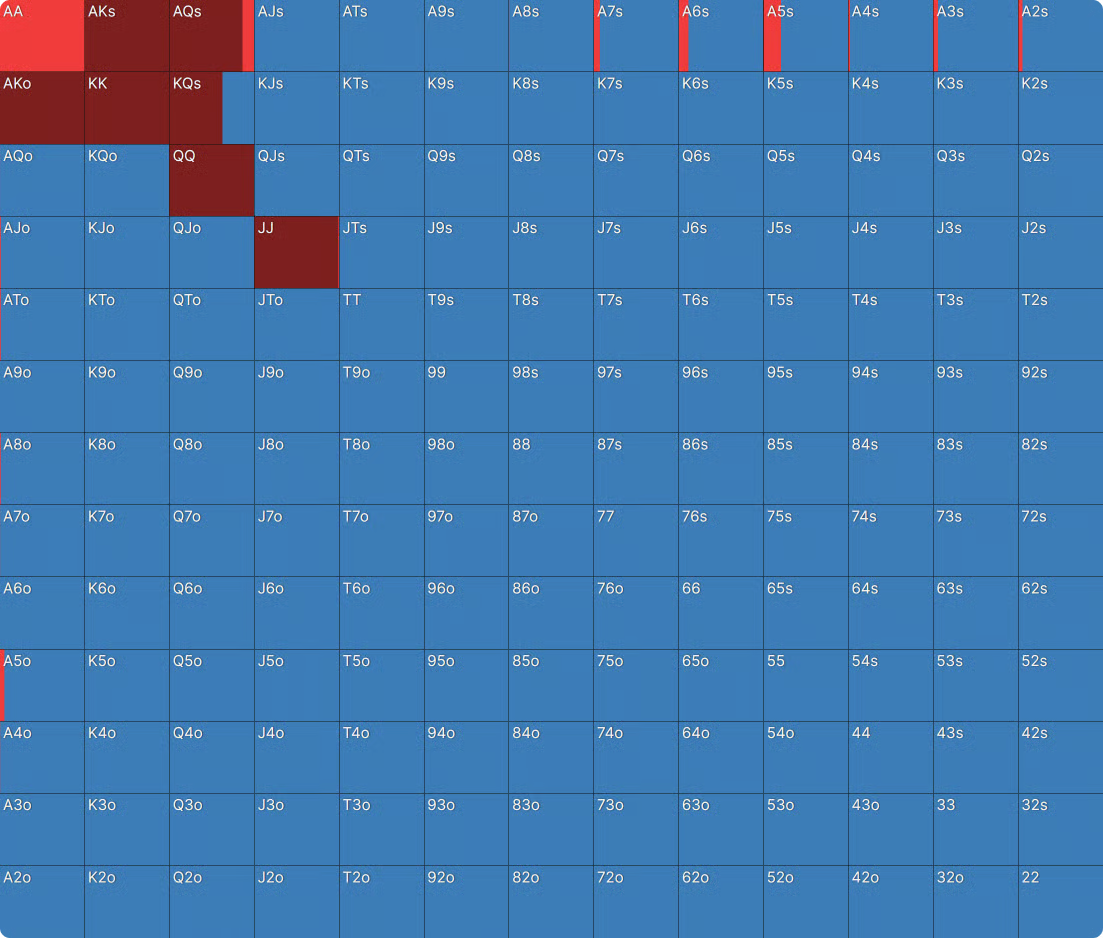

Most hands jam, but there is a small “click” range (that is, a min-raise) with AA for value and suited low Ace-x hands as bluffs. A 4bb bet over a 2bb open with a stack of just 9bb puzzles some players. Why would anyone fold to such a small raise, and can’t we simply never fold when a “click” is answered with a jam?
So, here is how UTG responds to our mini-3-bet:

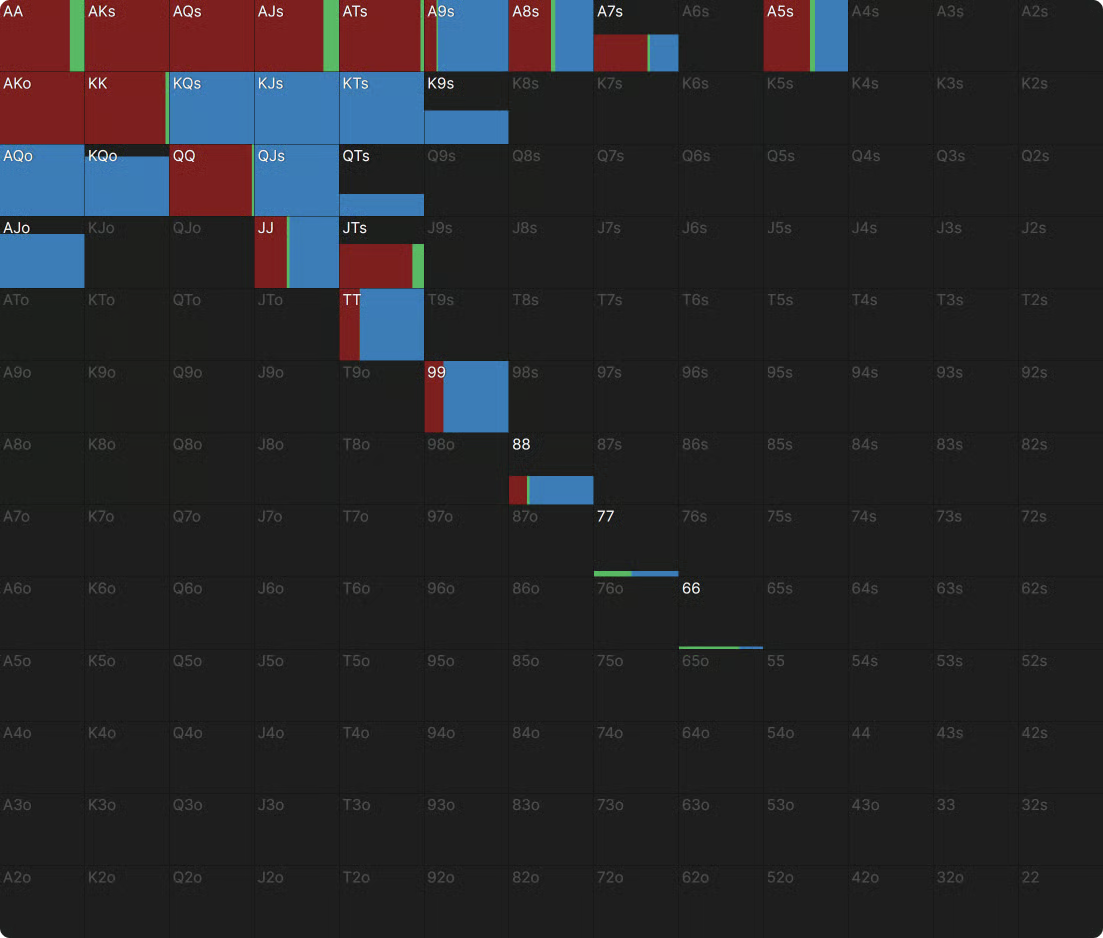
In fact, there are many folds here, and our bluffs make better hands fold. When UTG makes a 4-bet jam, HJ responds as follows:

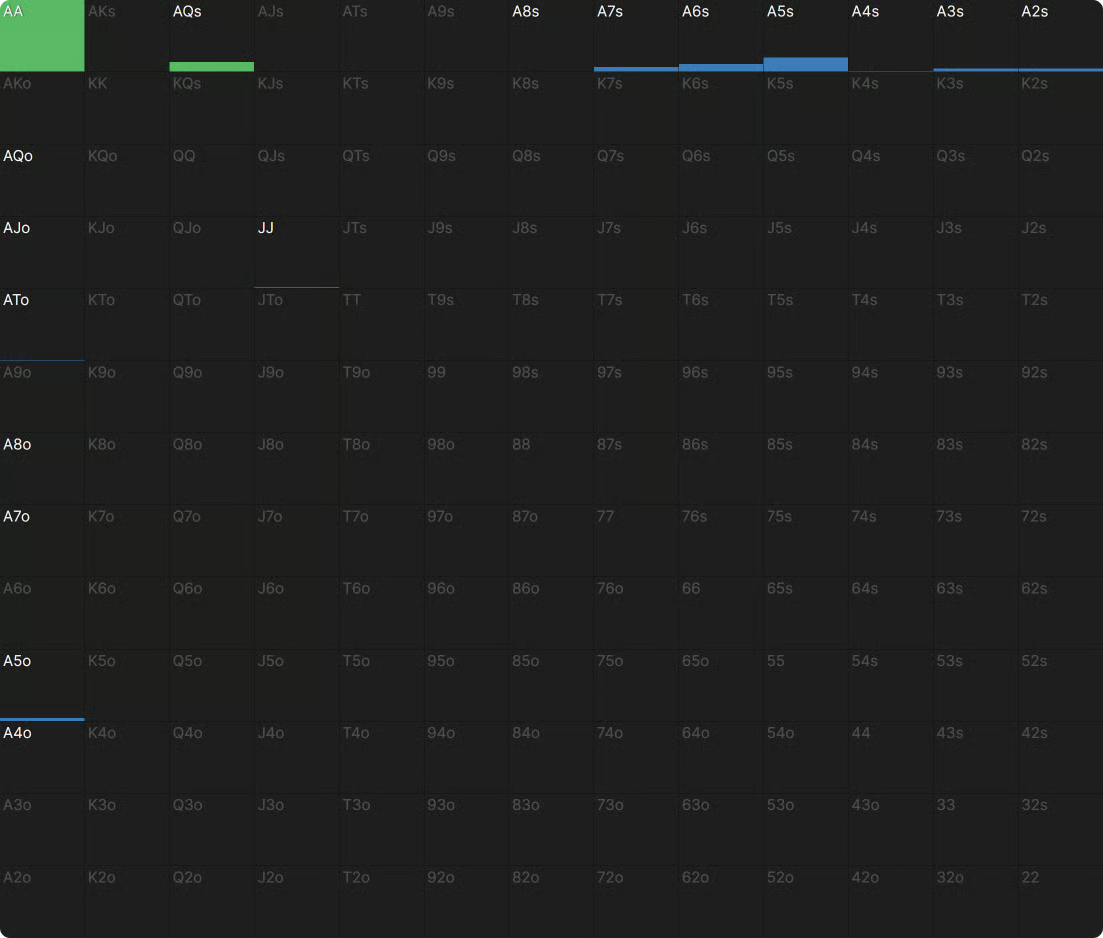
HJ does indeed fold. Players struggling with the sunk cost fallacy would decide in both situations that the players were already committed to the pot, even though that was not the case.
5. Survivorship Bias
Survivorship bias is:
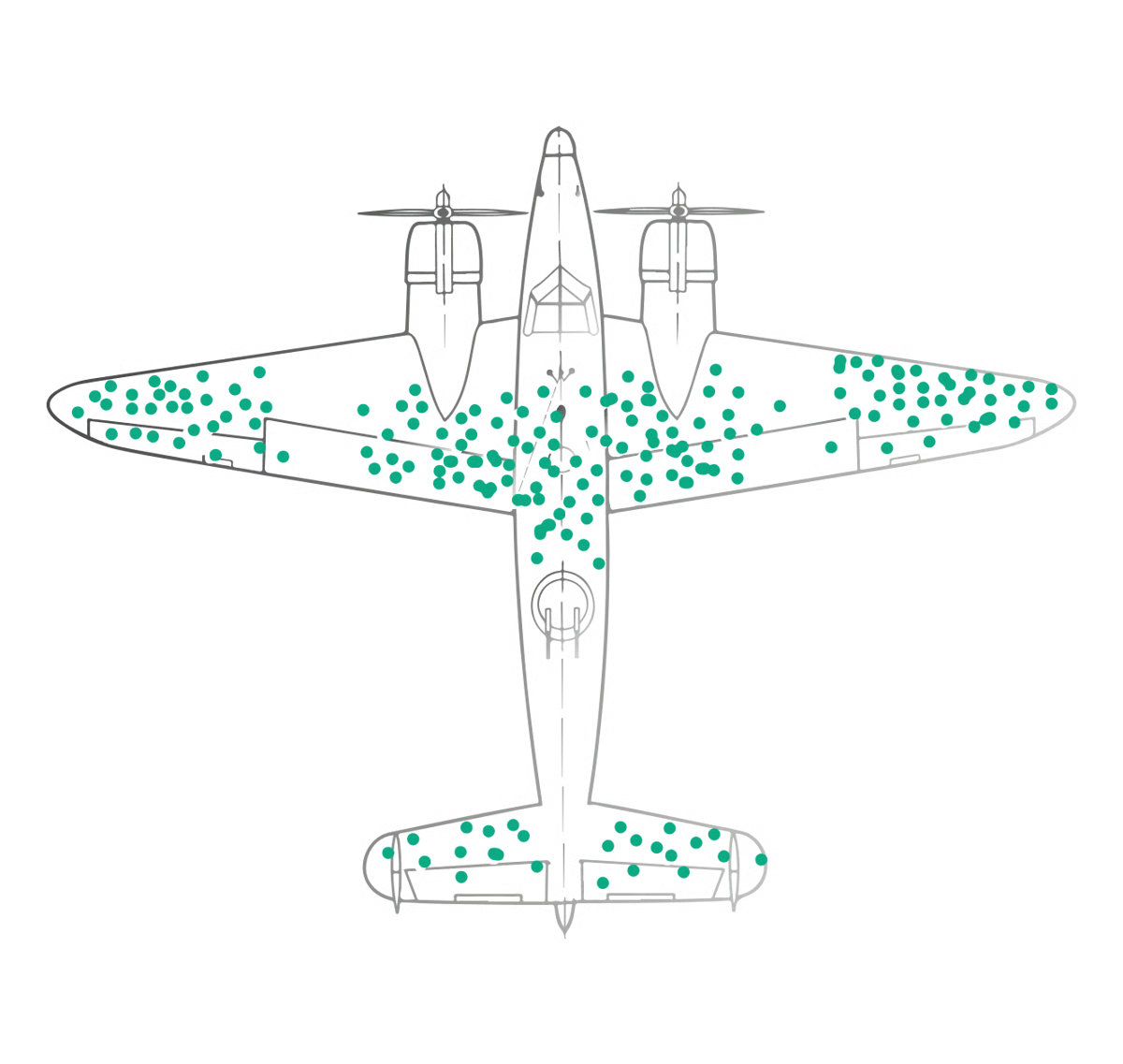
The mistaken tendency to focus on a sample of data that has passed through a selection process and overlook the data that did not pass it. We focus on the survivors — hence the name.
A very well-known illustration of survivorship bias is the analysis of Allied aircraft during World War II. The image below shows where direct hits landed on aircraft that returned from missions. Initially, this was used to plan where to place additional armor on aircraft for future missions. The logic was that more armor should be added wherever the aircraft had been hit.
Survivorship Bias in Poker
Survivorship bias is widespread in poker and leads, for example, to the community’s tendency to glorify players who have won major tournaments. There was a time when the winner of the WSOP Main Event was guaranteed a lucrative sponsorship deal, even though variance actually played a huge role in that result. I once happened to hear 2004 champion Greg Raymer say that he won 16 coinflips in a row on his way to the title. Putting poker players on a pedestal for winning one tournament and considering them unquestionable world-class players on that basis is a mistake, although in my opinion, Raymer became one of the great ambassadors of the game.
An even more dangerous consequence of survivorship bias arises when a poker player uses such isolated results to sell shares or even educational products. During poker’s golden years, when games were at their softest, many players stood out brightly and still possess great authority in this field. Anyone selling shares or advice should be treated with a healthy degree of skepticism (and it would be wrong not to point out that I am not a professional player, but merely an author with one foot in the world of solver'’s; you should also treat my words skeptically).
6. Prospect Theory
Prospect theory, formulated by Amos Tversky and Daniel Kahneman, states that losses and gains are perceived differently.
Losing causes more pain than winning brings pleasure. The theory states:
People are much more strongly motivated to avoid a potential loss than to obtain a potential gain.
This theory earned Tversky and Kahneman the Nobel Prize. When people are offered a choice between $50 and a 50/50 chance to win $100, most choose the guaranteed $50, even though the expected value of both options is the same. You often see this on TV shows such as ’Deal or No Deal’ or ’Who Wants to Be a Millionaire’. Contestants “earn” a certain cash prize and then become so attached to it that they accept a very unfavorable deal to preserve what they already have.
Prospect Theory in Poker
Prospect theory is constantly evident in poker. First, think about the number of coolers you suffer or deliver in a session. Over the long term, the number will be the same, but we remember the coolers and losses we receive much more strongly. We have all had sessions when we completely failed to notice or discounted the coolers we delivered to others, but felt a sense of injustice because of the ones that happened to us.
Prospect theory also manifests itself in the later stages of MTTs. Everyone knows that short stacks should play tightly near the bubble, but some players allow the blinds to gradually eat away at their stack in order to guarantee min-cash money and deprive themselves of a realistic chance to win. Prospect theory also explains why some people accept terrible deals at the final table to guarantee an amount they believe they deserve. I have my own example, which I managed to correct thanks to GTO Wizard. Here is the example.
BB checked, and UTG bet on the flop 

 . Here is BB’s response:

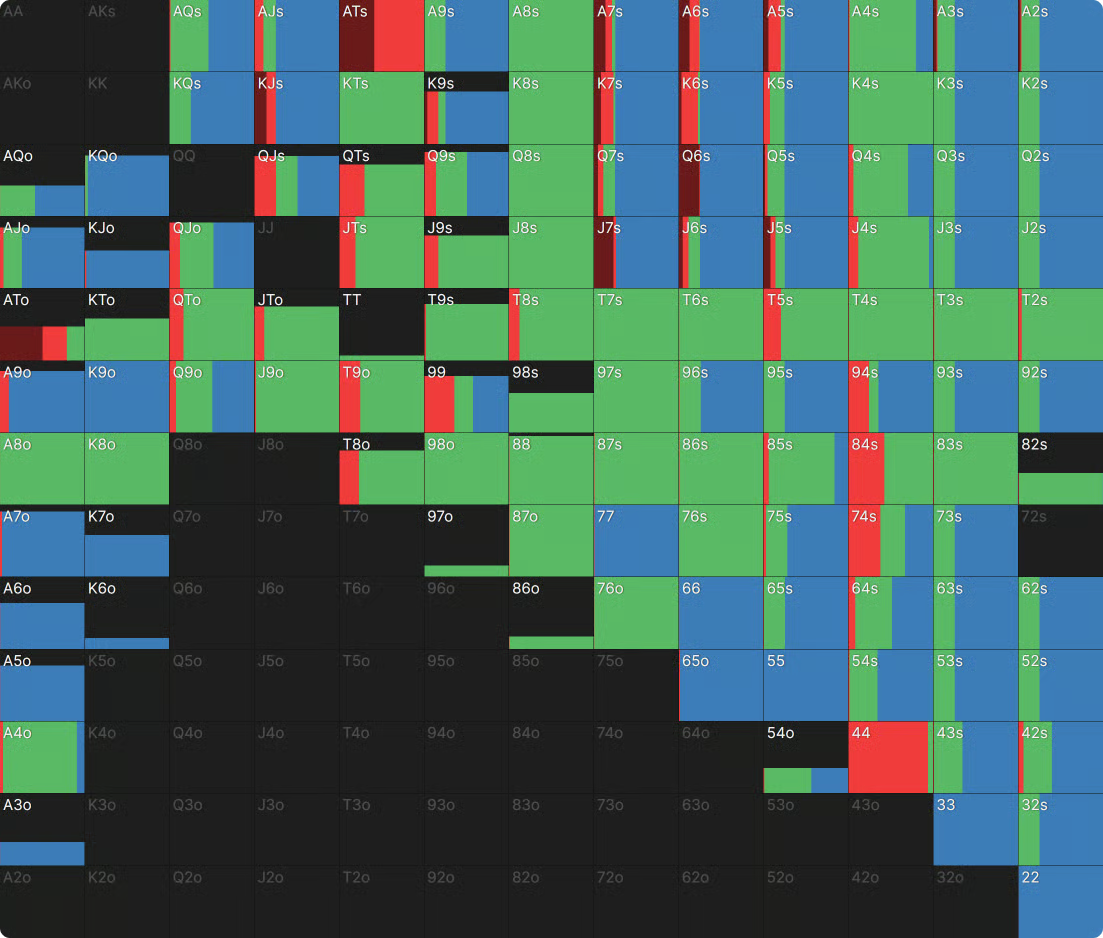
The best draws here are 
 ,
 ,

 and diamond draws that also paired the 4, such as
 and . Notice that almost all of them are played as calls rather than raises. A hand such as , has 68% equity and calls, while a “weaker” draw such as

 mostly raises, even though it has only 48% equity.
Many prefer to check-raise with the stronger draw rather than the weaker one, but this is suboptimal. The issue of equity realization arises here. Taking down the pot with , which has only 48% equity, is a good result. You under-realize your equity if you force your opponent to fold when you have 68% equity, as with . Calling with a hand like also allows you to preserve outs to improve to a pair more effectively, since a stronger range continues against a check-raise.
I struggled with this and always wanted to get it in on the flop with my strong draws. This was an expression of prospect theory, similar to the experiments in which people are offered $50 now or a 50/50 chance to win $100. I did not want to lose on the river with an unfinished draw and preferred to take the relatively more guaranteed pot on the flop while I still had plenty of equity, so I always bet in such situations and then felt mildly disappointed that I had not won enough. Ultimately, poker skill is measured not by the number of pots won, but by the amount of value created. This was a genuine leak that I fixed with the help of GTO Wizard.
7. The Illusion of Control
The illusion of control is:
The tendency to believe that we influence events more than we actually do.
This is why racehorses are given ambiguous and catchy names. Recent Grand National winners were called ‘One for Arthur’, ‘Rule the World’, ‘Don’t Push It’ and ‘Comply or Die’. Most of us can fit a meaning to at least one of these names. Does anyone in the room have a friend or pet named Arthur? This increases the likelihood that a novice will bet on that horse. A meaningful name gives a recreational player a feeling of some control over the outcome, even though they are actually just choosing horses at random.

The Illusion of Control in Poker
The illusion of control is also widespread in poker. We have all asked for cards when we were ALL-IN, and probably all said “just one time,” thinking that this would sway fate in our favor. Some players refuse to look at the flop when it is dealt, and so on. Even the phrase “I always lose with this hand,” said when you get it in with aces, is an example of a distorted sense of control, as though you are trying to remove your bad luck with a reverse spell. I am ending this article with the illusion of control because, in many ways, most cognitive biases contain this element.
8. Conclusion
One reason there are so many cognitive misconceptions and biases relevant to poker is that all of us, as humans, start with a poor understanding of variance and a very low tolerance for uncertainty. If you want to eliminate their root cause, you need to understand the concept of variance and learn to deal with uncertainty. But we can also work at a later stage — that is what we have done in this article. By examining the misconceptions that produce these errors and biases, we can help ourselves better manage this dangerous internal landscape. In this case, accepting the random factor in poker is an antidote to many such psychological traps.