

Translated with the help of AI. We apologize for any errors and would appreciate your help in correcting them.
In the world of psychology, there are always various psychological studies and experiments that you have probably already heard about. At the moment, a large number of studies are prohibited, as they may go beyond the designated ethics. We offer you to dwell on the 5 most interesting and learn a little more about psychology.
1. Loftus and Palmer Car Crash Experiment
The study was conducted in 1974 at the University of California, Irvine. The participants of the experiment were asked to view the slides of the car accident and then describe what happened, as if they were witnessing the events.
At the same time, the group members were divided into 2 camps: they were asked the same questions, but with different wording. For example: "how fast was the car driving at the time of impact?" and "how fast was the car moving when it crashed into another car?" The results of the study showed that the use of different verbs influenced the participants' responses. Many psychological experiments subsequently confirmed the findings of Loftus and Palmer.
Now the "addition" of false information in the memory of a particular event is called confabulation. A person's memory can be easily manipulated using the survey method.
2. Martin Seligman experiment
In the course of this study, the phenomenon of “learned helplessness” was revealed. The experiment is ambiguous, since there is an element of violence in it, but at the same time a rather interesting phenomenon was revealed. During the study, the dogs were affected by the ringing of the bell, and after it — a light "touch" of electric current. After a series of repetitions, as soon as the dog heard the call, it reacted as if it had already been electrocuted (shaking, bending its paws, lying on the half).
The classic Pavlovsky reflex was also revealed here. But the second part of the experiment became interesting. The dogs were placed in a large cage separated in the middle by a small fence over which they could easily jump. However, the floor on one side of the fence was half energized. Seligman placed the dogs just on the side where the floor was energized and gave a small discharge. The dogs were expected to run to the safe side of the cage, but they simply lay down on the floor and refused to take any measures to reduce the tension.
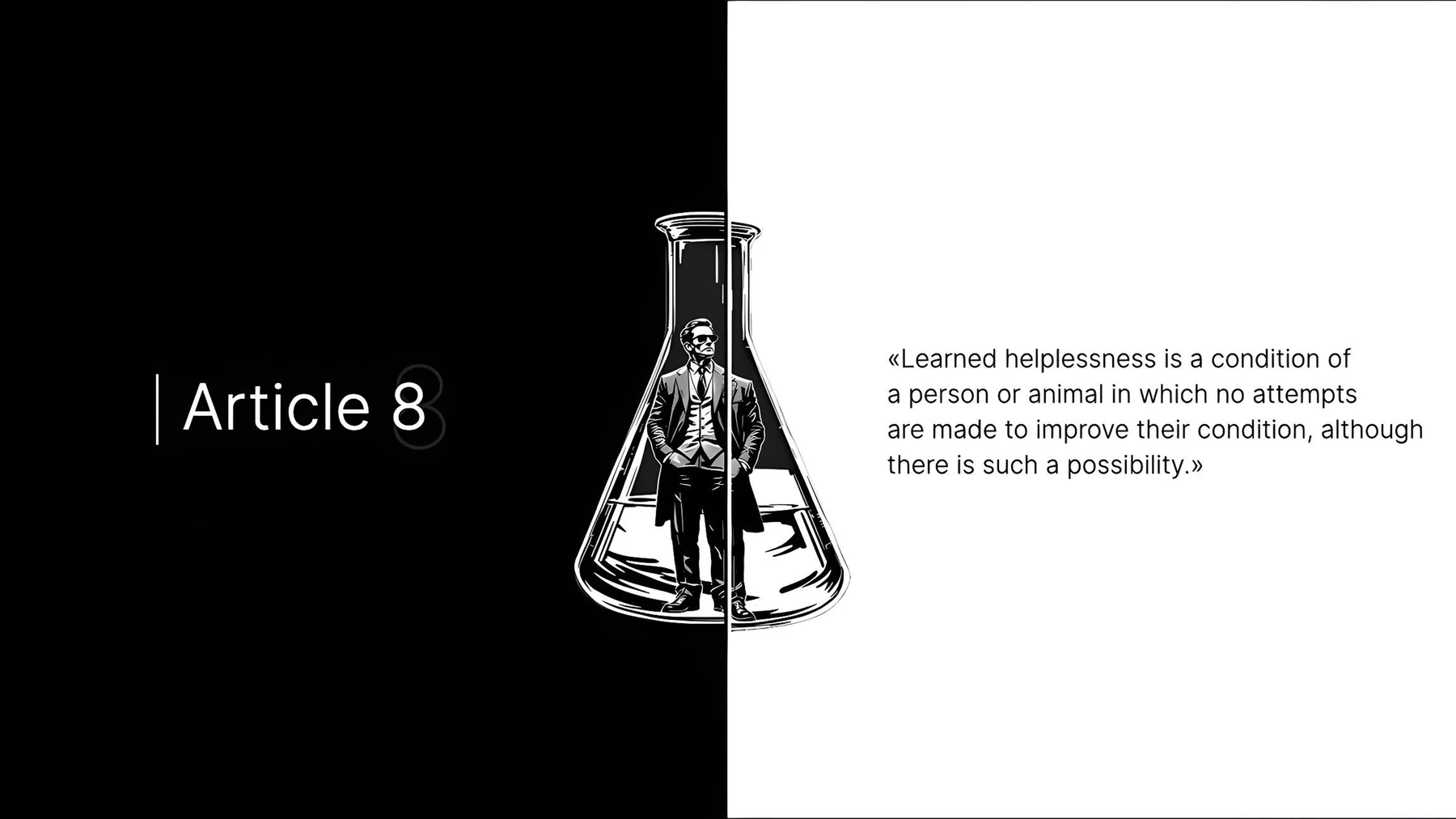
Thus, learned helplessness was revealed — the state of a person or animal, in which no attempts are made to improve their condition, although there is such a possibility.
To prove this hypothesis, the researchers brought another group of animals and found that dogs that did not participate in the first part of the experiment easily jumped over the fence and looked for ways to avoid danger.
3. F. Zimbardo's Stanford experiment
This is one of the most popular studies in psychology. A prison psychological experiment was conducted to study the behavior of ordinary people when they were either in the role of a prisoner or as a jailer. College students were recruited to participate, who were divided into 2 groups: guards (jailers) and prisoners. The basement in the building where the experiment took place was equipped as a prison. Everything possible was done to make it look as realistic as possible. The guards were tasked with running the prison for two weeks.
They were prohibited from physically harming prisoners. Both groups knew they were just playing roles. A few days later, the guards became very aggressive towards the prisoners, and many prisoners began to behave compliantly in front of the guards. The experiment had to be stopped because some participants showed signs of mental distress. Although this study of conflict in psychology was conducted extremely unethically, it is believed that the results showed how much a person's behavior depends on a particular situation and on the role that he plays in it.
4. The experiment of Richard Nisbett and Timothy Wilson – the Halo effect.
In the experiment, college students were asked to evaluate the teacher based on his video interview. Students were randomly assigned to two groups. Each group was shown different interviews with the same instructor.
- In the first video, the instructor looked pleasant, respectful of his students and passionate about his subject.
- In the second interview, he looked untidy, cold, distrustful, and strict.
After watching the video, the participants were asked to rate the lecturer on appearance, manners, and accent (the manners and accent were the same in both videos). Students were asked to rate the professor on an 8-point scale: from “extremely like” to “extremely dislike”. They were also asked to explain how their liking for the teacher affects their assessment. It turned out that how the students rated the lecturer did not depend on what he said.
The main factor was sympathy.
So the "halo effect" was revealed – the halo effect – the first impression effect. A person under the influence of this effect allows us to generally assume that beautiful people are also smart, friendly and sensible people.
This is due to cognitive distortion, a general impression of something (a phenomenon, a person, a thing) on the perception of its particular features.
5. The Lee Ross Perception Study
In 1977, Lee Ross, a professor of social psychology at Stanford University, conducted an experiment that shows how people can mistakenly believe that others think the same way they do. Ross's psychological experiments were aimed at showing how the “false consensus effect” works in humans. In the first part of the study, participants were asked to read about the situations in which the conflict occurred, and then they were offered two alternative ways to respond to the situation.
They were asked to answer 3 questions:
- Which option will other people choose?
- Which option will they choose?
- What qualities are inherent in people who choose each of the two options?
Analysis of this psychological experiment showed that most subjects believed that other people would do the same as they did. This phenomenon is called the false consensus effect. The second observation was that participants made bold and negative predictions about those who did not share their choices. Thus, it was revealed that all people have a consensus effect - a tendency to project their way of thinking on other people. In other words, people tend to believe that everyone else thinks the same way as they do. If you want to get to know yourself better and find out your features, we invite you to classes with poker psychologist Sofia.