


Translated with the help of AI. We apologize for any errors and would appreciate your help in correcting them.
During my tournament activity, I did not immediately come to the need to use 4-beta. Of course, I mean its bluffing component. In 2019, I was not very often tribetized, and I rarely thought about 4-beta as a bluff. However, as we know, poker is a game whose trends change over time: the spectra of opening, protection, 3-bets, check raises, etc. are expanding. And the range of 4-betting was no exception.
When you begin to tribalize too often, you must take appropriate measures. Obviously, constantly folding, continuing only on the super-narrow edge, means playing a game with opponents under the well-known name exploit, in which you yourself become a victim. It is the 4-bet that will become the formidable weapon that will help you defend against wide 3bet opponents. One of the biggest advantages of this 4-beta bluff is that by besieging another aggressive opponent in this way, you will most likely be able to breathe quietly for a while. Let's take a closer look at the 4-beta range in poker.
1. Velho range 4-beta in poker value
Let's start our analysis with the obvious - the 4-beta Velu-band.
- In 40bb + stacks, I wouldn't want to 4bet monsters like QA and AA in 100% situations.
- In most cases, I will set a trap by simply calling 3-bet, and get the extract value from the aggressive opponent on the post-flop to the maximum.
- I realize that there is a chance in some spots to run into a suckout, but I believe that playing more often through a call is the most profitable concept.
- I will not attribute this strategy to playing in smaller stacks (20-25 bb), because with such depth, there are enough hands that will pay us.
The AK hand is also an important part of the 4-beta on the value. Especially in such stacks as 40-50bb we have a fairly simple and comfortable play for us. Here you can simply put the all-in in response to the 3-bet from the opponent, and make a flat 4-bet (of course, with a willingness to call a possible Push). On the contrary, in the deeper stacks (70bb +), the decision to play 3-bet just call looks more reasonable and optimal, since with AK we do not want to stack-off in case of all-in, and fold such a strong hand is quite annoying. However, the decision to play in the early stage with AK (both suited and offsuited) on the 80-100 bb stack will not be a critical mistake, and at the long run you are unlikely to go negative in such spots, but you will increase the variance fluctuations.
These arguments are absolutely not applicable to possible collisions of two big stacks, for example, on the final table, where we are forced to make decisions in a rigid ICM.
QQ is perhaps the last hand that closes the 4-beta range exclusively.
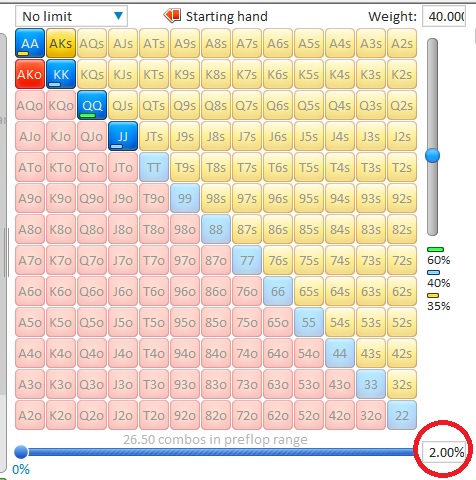

QQs will be good in both 4-beta and the 3bet circle. In the case when we are kolim, the only drawback is that we will not feel very pleasant on the boards with an ace or a king. The obvious advantage (in those cases when we play through the call of 3bet) will be a light and confident post-flop on the low boards of various structures, both coordinated and dry, as well as paired, where we will maximize the extract value from middle pocket pair, as well as Ah and Kh, who did not catch their gain.
After all, we are second only to QC+ combinations, which make up only a small percentage of the range of opponents. As for JJ, you can play them quite flexibly: in stacks 40-50 bb it is quite permissible to all-in against 3bet from an aggressive opponent, and in deeper (70bb +) stacks you can consider the 4-bet/fold line if we encounter 5-bet push. In general, with JJ, the best solution would be to balance your strategy between 4-bet and call 3bet, starting in your decision primarily from the style of our opponent: against an aggressive opponent - 4-bet, and against more nifty guys - call 3bet, followed by a thoughtful and neat post-flop game.
2. Building a 4-beta range in a bluff as a bluff
Expanding our 4-beta range, we want to first add hands with blockers on A and K, because these are the hands that will block the top of the 3bet range of the opponent, against which we would not like to play. That is, if you bet 4-bet with an A5s hand, the probability that at the moment your opponent will have, for example, AK will decrease by 25%. Also note that you will be 50% blocking pocket aces. In fact, this is the basis of combinatorics, on which the correct understanding of the concept of blockers and how it is most profitable to use it is based.
Remember that the two main mistakes that occur in working with blockers are either a complete reliance on them ("Yes, I have an ace, he will almost never have an ace here") or a complete ignorance of this aspect (most often due to ignorance of it). Hence the idea of adding Ah and Kh hands to the bluff 4-beta range. Please note that technically, hands such as AQs, AQo, KQs, KQo, KJs are great for 4-beta from the point of view of blockers (some of them even contain two blocker to the opponent's vela range), but it is rather pathetic to turn them into a bluff, so it will be more profitable to play them more often through call 3bet. In the figure below, this group of hands is represented in the range of 4-beta with a low frequency of 25%, that is, the remaining 75% is quietly taken to 3bet call.
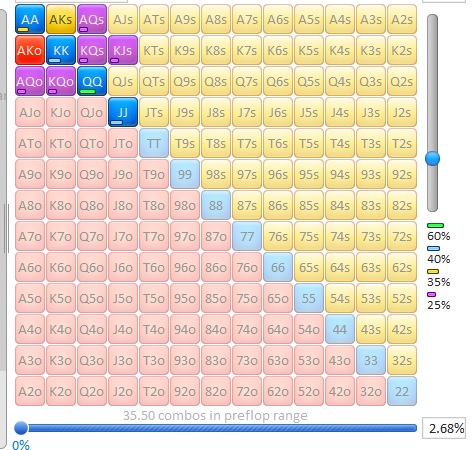
Ideally, it is preferable to take the weaker hands to the 4-bet, with which you do not have a good counter-game as a 3-bet collector.
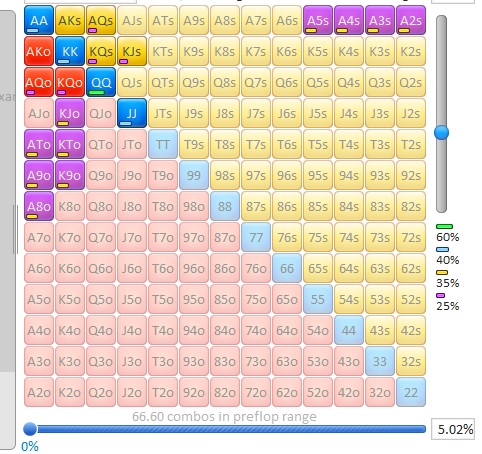
3. In what positions and against what positions do we want to use 4-beta in a bluff as a bluff
It is necessary to understand that our 4-beta range will be wider or already depending on the position of our opponent. Situations in which protection through 4-beta is most often necessary are the following: HJ vs BU, HJ vs CO, CO vs BU, BU vs SB, BU vs BB, etc. This is due to a more aggressive game with extended spectra of 3-bets in later positions. A more detailed analysis of the 4-beta ranges can be found in the video courses on Alexey Exan13 preflop “Level 1” (buy-ins up to $11), “Level 2” (buy-ins 11-33$) and “Level 3” (buy-ins over $33), based on the sources of large databases of real hands of players of different limits.

Two varieties of 4-beta
There are two radically different varieties of 4-beta. Let's look at both.
- 4-bet against 1 opponent - You are on CO, and everyone has defended you. You open with a mini-raise in an effective 50bb stack with a hand

 and get a 3-bet from an aggressive BU up to 8 bb. You increase to 17 bb.
 - 4-bet - Squeeze - you are on the BU with your hand

 . The lusovo-passive fish opens with UTG at 2.2bb. You can see from the stats that he has a great 3-bet fold. But a good regular player with MP also notices this and puts the 3-bet up to 7bb. Next, you turn a good hand into a bluff as a bluff, taking into account the situation, as well as using two blocker in your hand at once, and raise it to 15 bb.
So, as we can see from both examples, a 4-bet bluff is possible against both one and two opponents. Sometimes situations are so suitable that it is possible to neglect technical points a little.
- Let me give you a couple of examples.
On the offline RPT series in Minsk in 2021, I 4-betil with SB


And the whole thing is in the situation: for two laps (we played a standard 9-max table), a loose-passive amateur on CO opened and folded on 3-bet from a rather aggressive reg player with BU. And when this situation repeated for the third time, I decided to start absolutely any starting hand in 4-bet. In addition to the good situation, I had a suitable stack (about 80 bb), while the opponents had a stack depth of no more than 40-45 bb. That 4-bet passed, as they say, “with a bang”, they all threw it away, and I got additional chips in my stack and pleasant memories in addition. Another similar situation occurred at the finals of one of the IPOKER network tournaments. Here, in any case, I had a good blocker, and, as in the first example, incredibly suitable opponents. However, it is worth noting that at the final tables, any such move combines both potential profits and serious risks, because unlike 3bet, 4bet is always a rather costly action.
4. sizing 4-beta
So we smoothly approached a very important aspect: which sizing to choose for such a reception?
- In the case of 3-bets - (if you follow the classical settings) we choose 3x of the opponent's bet when we are in a position against the opponent, and a slightly larger raise size (3.5-4x) when we are without a position.
- But with 4-beta, a slightly different philosophy - 4-bet itself is, as a rule, a demonstration of superpower, since it is played on a very narrow range. Therefore, even a fairly “flat” 4-bet will generate a ton of fold equity for you!
Let's consider the scheme of distribution development in more detail:
- standard raise of opening 2 bb;
- 3-bet 7 bb;
- 4-bet 15-16bb.
- That is, it is enough to increase the opponent's bet (meaning the opponent's 3-bet) by only 2.2 times.
- Why does it work? Imagine yourself at a relatively late stage of the tournament. Let's say you play in effective 45 bb stacks.
- A player with an MP unknown to you opens with a mini-raise of 2 bb.
- You and

 you decide to 3 bet, because you do not want to create a potentially unfavorable situation for you (for example, you have an aggressive table, and you are afraid of squeeze from aggressive reg players from later positions).
 - You 3-bet up to 6.5 bb and get 4-bet up to 14 bb.
The most likely scenarios in the case of your call are:
- you do not fall into the board, and you have nothing more to catch in this spot.
- you cling to the board, hitting an ace or a jack. But, given the dynamics of the distribution, this hit rather binds you to the bank, while absolutely not guaranteeing you a margin of equity against the range of your opponent. Therefore, if you are a thinking player, you will easily fall on the preflop.
Please note that I am absolutely not trying to criticize 3-bet against MP s . On the contrary, I believe that the 3-bet/fold line in this case will be as close as possible to the optimal one.
5. Conclusion
To summarize all of the above:
- 4-bet (both on value and as a bluff) can become a powerful weapon against aggressive players with a high frequency of 3bet.
- The range of 4-beta is expanding mainly due to the presence of blockers on A and K.
- To use 4-beta more effectively, look for suitable situations and suitable opponents
- The late stages of tournaments (pre-bubble, pre-final, etc.) are ideal for both 4-bet moving and in general for a more aggressive game, since in the final stages of MTT the fold equity chart of your opponents is always close to its peak values.